Best App for Texting Anxiety (What Actually Helps in 2026)
Texting anxiety is real and it affects how you reply, how long you wait, and whether you reply at all. Here are the tools that actually help.
The text came in twenty minutes ago. You still haven't replied.
Not because you don't care. Not because you're busy. Because every possible response feels wrong and your brain has locked up trying to find the right one.
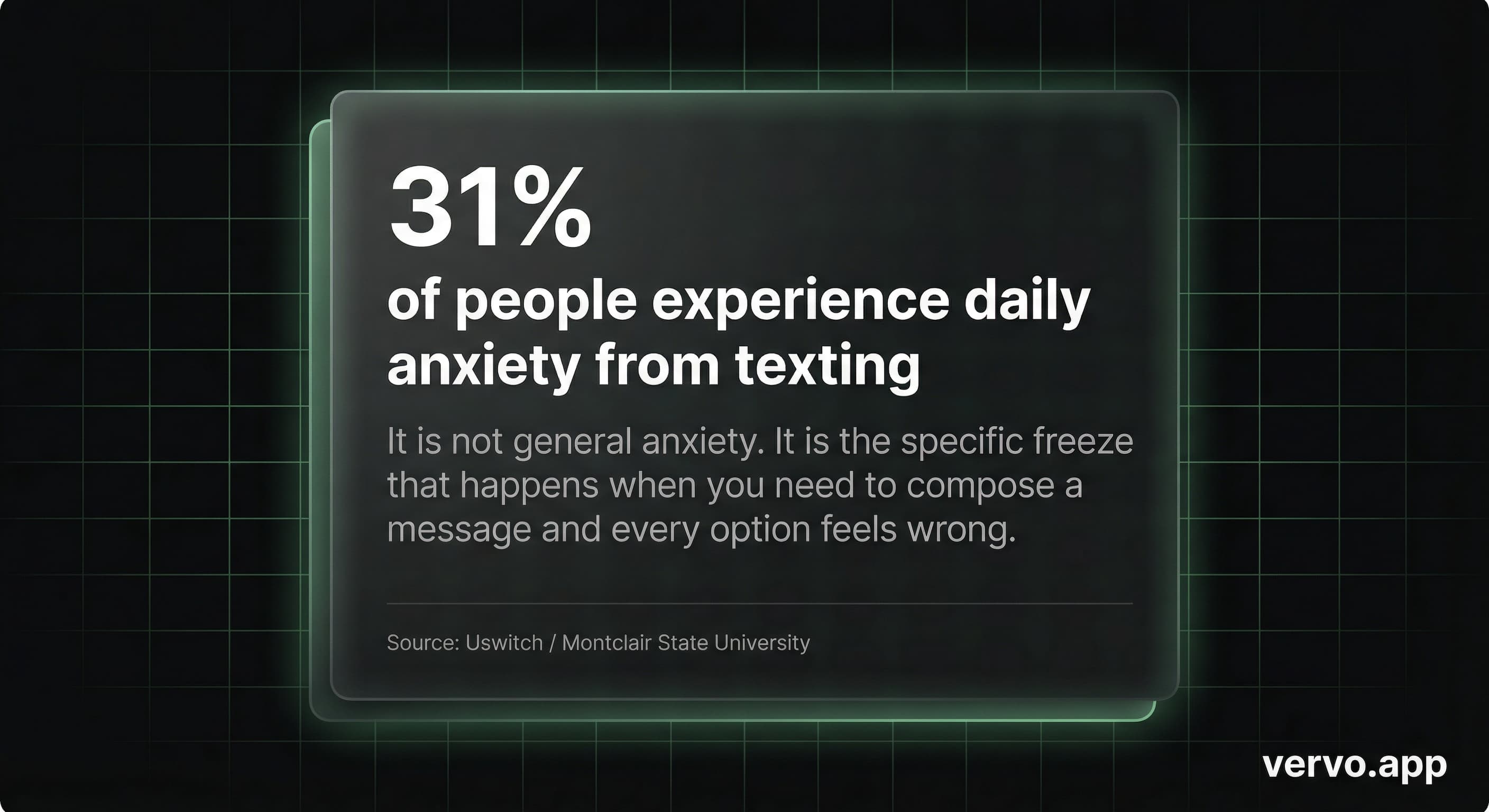
This is texting anxiety. It affects 31% of people on a daily basis, according to research on digital communication stress. For Gen Z specifically, the numbers are even worse. More than half experience daily anxiety. And texting is one of the biggest triggers.
If you've ever googled "app for texting anxiety" hoping something would just fix this, you're not alone. The question is whether any of those apps actually work.
What Is Texting Anxiety?
It's not general anxiety. It's not social anxiety in the traditional sense. Texting anxiety is the specific freeze that happens when you need to compose a message and every option feels wrong.
The American Psychological Association calls it choice overload. When you have too many options with no clear right answer, your brain defaults to inaction. The blank text field is the ultimate choice overload scenario. You could say anything. Which means you end up saying nothing.
The symptoms look like this. You read a message. You start typing. You delete what you typed. You retype something different. You delete that too. You close the app. You tell yourself you'll reply later. Later turns into tomorrow. Tomorrow turns into a week. Now the silence itself has become the problem.
If the overthinking cycle sounds familiar, you know exactly what this feels like. It's not about the text. It's about the infinite possibilities contained in a blank field.
Why Does Texting Make Anxiety Worse Than Talking in Person?
In person, you respond in real time. Someone says something. You say something back. There's no time to second-guess because the conversation keeps moving. Your brain just produces words. They're usually fine.
Texting removes the time pressure and replaces it with infinite time to second-guess. That sounds like a gift. It's actually a trap.
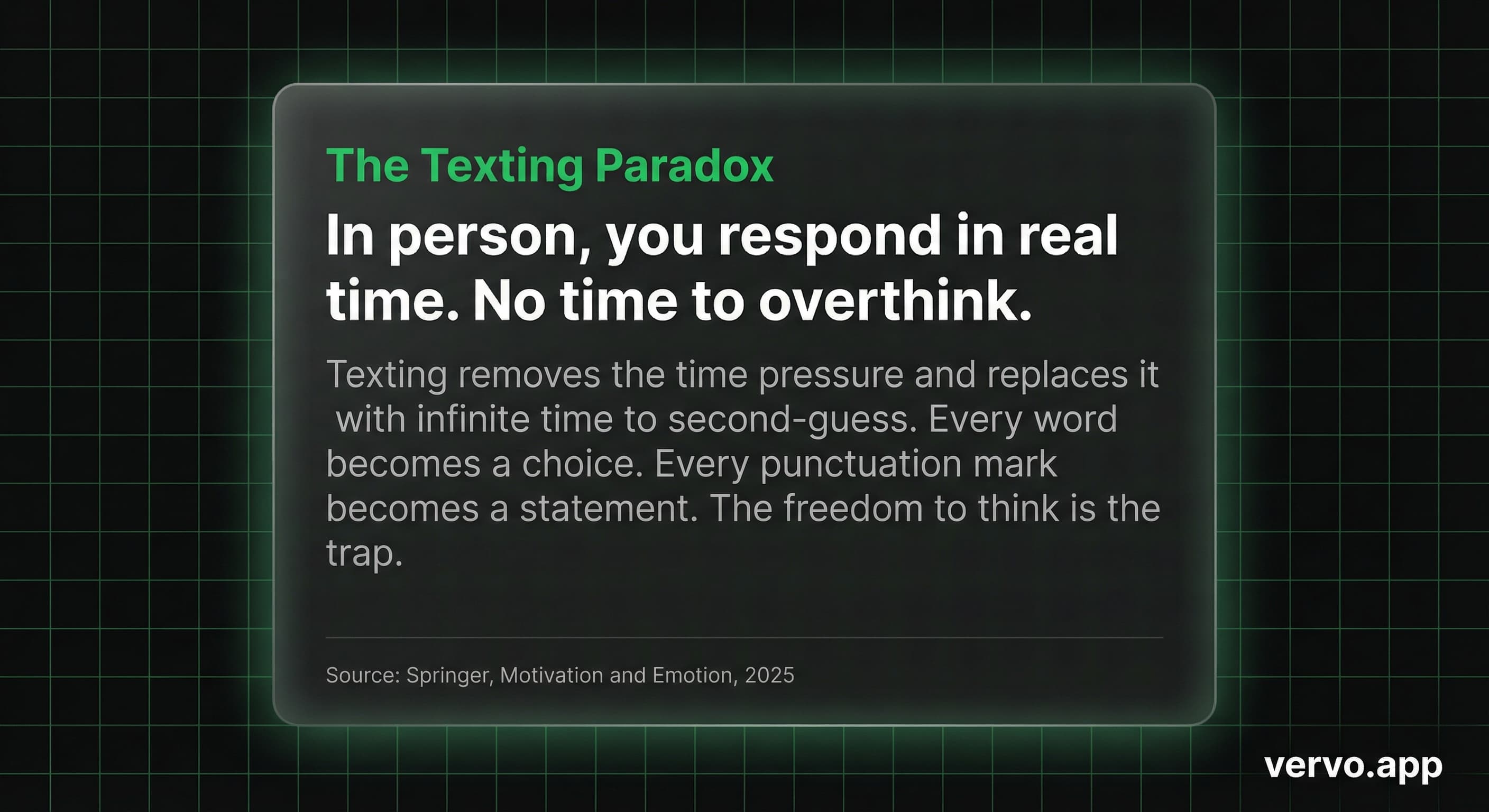
When you have unlimited time to craft the "perfect" response, your brain starts treating a casual text like a college essay. Every word becomes a choice. Every punctuation mark is a statement. Should you use a period? Too formal. An exclamation point? Too eager. No punctuation? Too casual.
Research from Springer on instant messaging and social anxiety confirms what most people already feel intuitively. Text-based communication increases anxiety because it strips away the non-verbal cues that normally carry meaning. Your smile. Your tone. Your body language. All gone. Now you're trying to pack all of that information into twenty words. That's an impossible task.
What Kind of App Actually Helps With Texting Anxiety?
Three categories of apps claim to help. Only one addresses the actual problem.
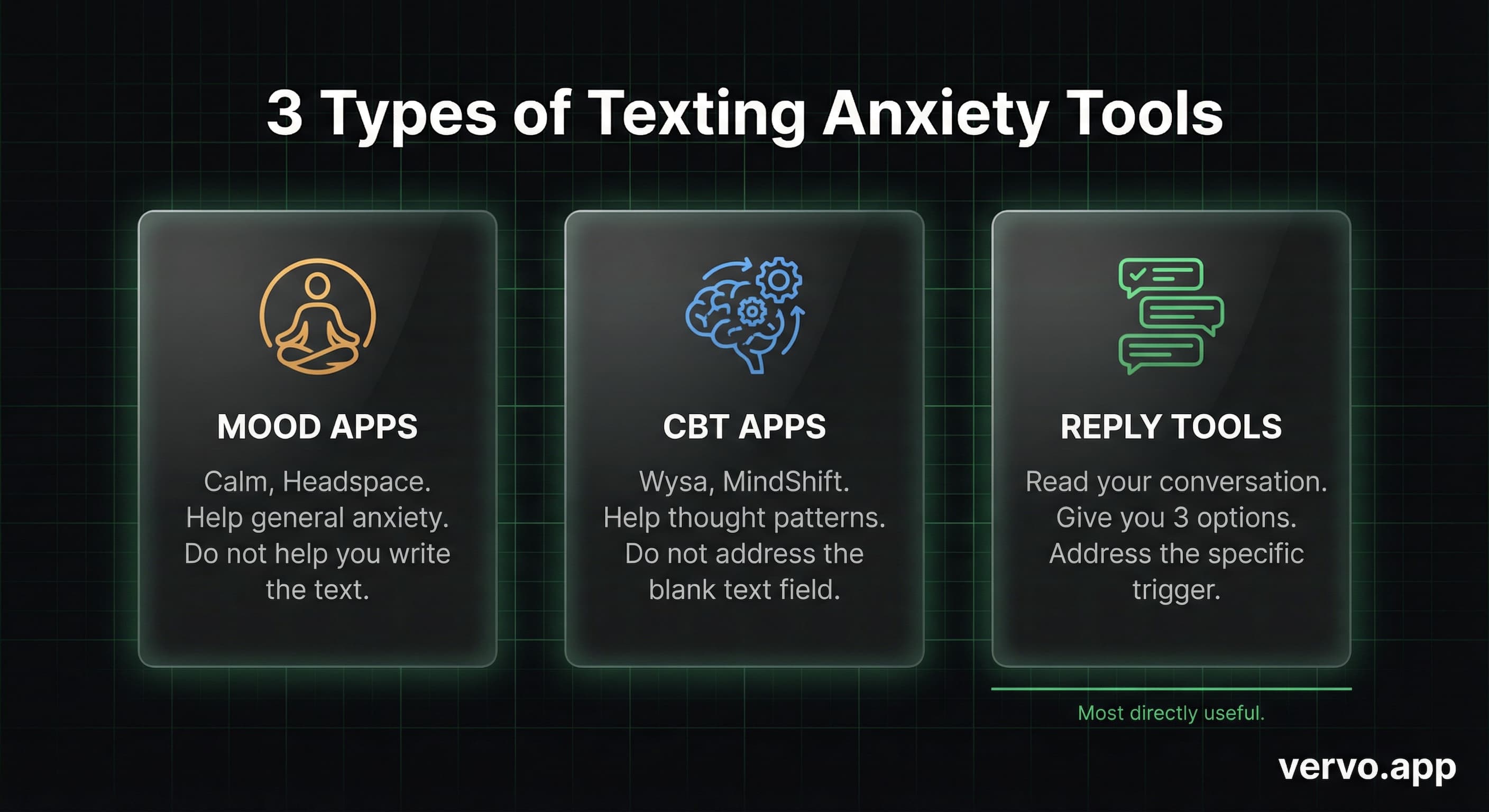
Category one: general anxiety apps. Calm. Headspace. Finch. These help with overall mood and nervous system regulation. They're good at what they do. But when you're frozen in front of a specific text, a breathing exercise doesn't solve the problem. You still have to write the reply. The blank field is still blank.
Category two: CBT and therapy apps. Wysa. Woebot. Youper. These help with thought patterns over time. They teach you to recognize cognitive distortions and reframe anxious thoughts. Valuable for building long-term resilience. But in the moment you're paralyzed over a text from someone you're dating, they don't give you the words.
Category three: reply suggestion tools. These bypass the blank field entirely. You upload a screenshot of the conversation. The tool reads it and gives you options. Your brain goes from "I have no idea what to say" to "not that one, that one."
The third category is the most directly useful because it addresses the specific trigger. The anxiety isn't floating. It's pinned to a blank text field. Removing the blank field removes the trigger.
How Do Reply Suggestion Tools Reduce Texting Anxiety?
The blank field equals infinite options. Infinite options equals paralysis. This is choice overload in its purest form.
A reply tool shows you three options. Now you're not generating. You're choosing. Multiple choice is easier than open-ended. Every standardized test you've ever taken proves this.
Three replies appear. One casual. One warm. One direct. You scan them. One feels right. You tap, paste, send. What took forty minutes now takes ninety seconds.
The relief isn't the AI writing for you. The relief is not staring at nothing. The paralysis comes from the blank field. The tool fills it with options. Options are easier than blanks.
Research on decision-making supports this. When people are given a manageable number of choices instead of unlimited options, they make decisions faster and with less regret. The APA study on choice overload found that reducing options actually increases satisfaction with the final decision. You're not settling for less. You're escaping the trap of infinite possibility.
What Should You Look For in a Texting Anxiety Tool?
Not all tools are built the same. Some introduce new problems while solving the original one. Here's what matters.
No keyboard access. Some apps install as keyboard replacements. They read everything you type in every app. That's a privacy problem. A tool that works from screenshots only reads what you choose to show it.
No message reading. Related but different. Some tools ask for access to your actual messages. A screenshot-based tool processes an image. It doesn't need access to your inbox.
Multiple tones. One reply isn't enough. If the tool gives you a single option and it doesn't feel right, you're back to the blank field. Three options in different tones means you can pick the one that sounds like you.
Explains why each reply works. This is the difference between a crutch and a learning tool. "Say this" is temporary relief. "Say this because it acknowledges their concern while redirecting to a practical next step" is something you carry forward. The next time you're in a similar situation, you might not need the tool at all.
No account required to try. If a tool makes you create an account and enter a credit card before you can see if it works, walk away. A tool that's confident in what it does lets you try it first.
Vervo hits all five. Web-based. Screenshot-only. Three tones. Explains the reasoning. Five free replies a day, no account required. That's the baseline for what a texting anxiety tool should offer.
Can an App Really Fix Texting Anxiety?
Honest answer. No app fixes anxiety. Anxiety is complex. It has roots in your nervous system, your history, your patterns of thought. No screenshot tool is going to rewire that.
But the right tool removes the specific trigger.
Think of it like a calculator. A calculator doesn't make you good at math. It removes the barrier to finishing the problem. You still have to know what you're trying to calculate. But the mechanical part? The part where your brain grinds through arithmetic? The calculator handles that.
A reply tool works the same way. You still have to know what you're trying to communicate. You still have to read the options and decide which one fits. But the mechanical part? The part where your brain freezes trying to generate words from nothing? The tool handles that.
That reply took ten seconds. Not because texting anxiety disappeared. Because the blank field did.
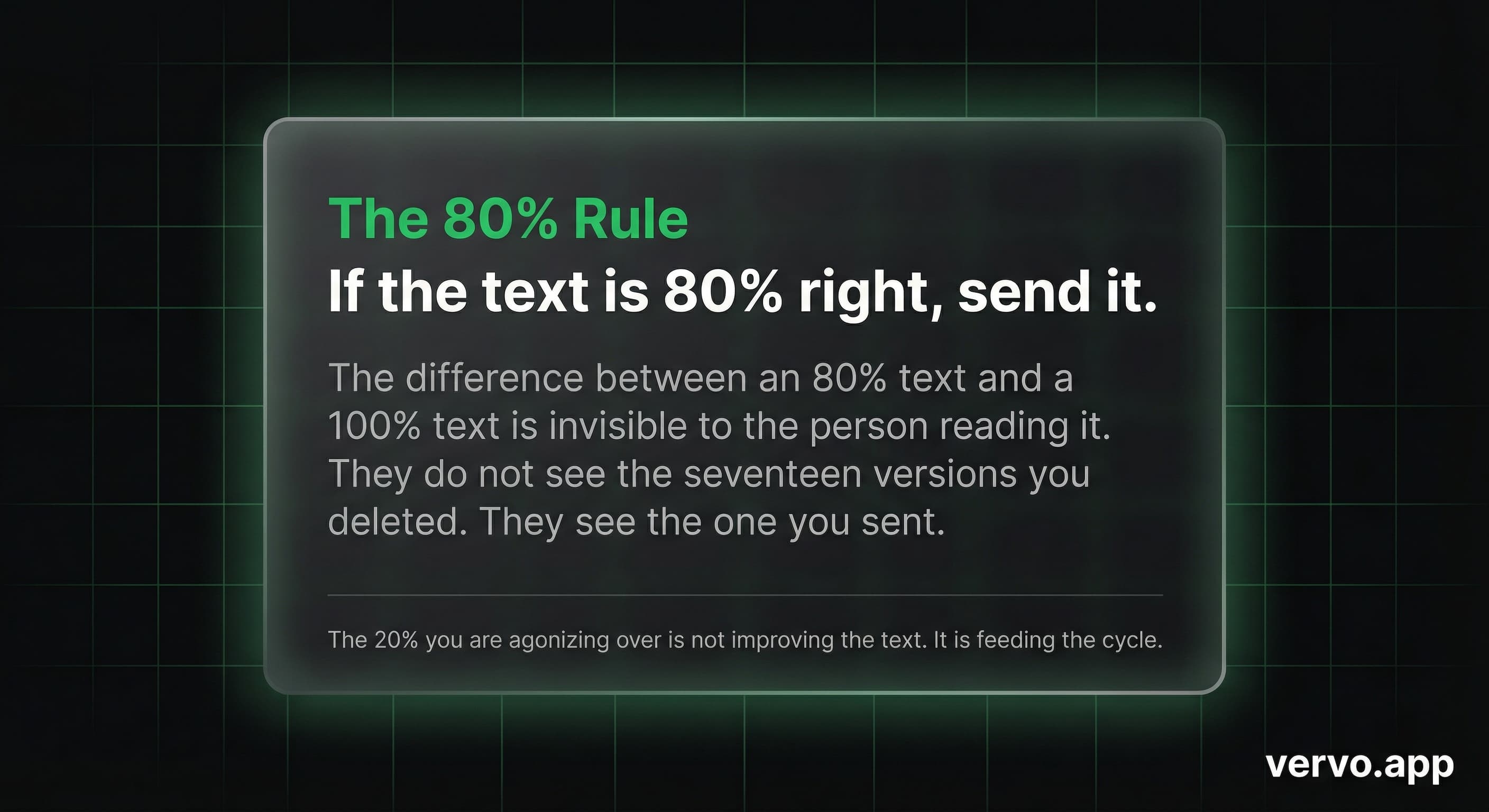
The other piece that helps is the 80 percent rule. If your text is 80 percent right, send it. Not 100 percent. Not perfect. Eighty percent.
The difference between an 80 percent text and a 100 percent text is invisible to the person reading it. They don't see the seventeen versions you deleted. They see the one you sent. If that one is 80 percent of the way to what you wanted to say, it's doing its job.
Combine a reply tool with the 80 percent rule and most texting paralysis disappears. The tool gives you a starting point. The rule gives you permission to send it. The shame spiral of unread texts never gets a chance to form.
How Do You Actually Use a Tool Like This?
The flow is simple. Take a screenshot of the conversation. Upload it. Pick a reply. Edit if you want. Send.
That's it. No complicated setup. No learning curve. If you've ever screenshotted a conversation to send to a friend for advice, you already know the first step.
The difference is speed. Your friend might respond in an hour. Or three hours. Or tomorrow. The tool responds in seconds. And it gives you multiple angles to choose from.
For moments when you're frozen and the blank text field feels like a wall, this is the fastest path through. Screenshot. Upload. Pick. Send. Done.
Five free replies a day at vervo.app.
Sources
- American Psychological Association, "Choose Quickly or Naught: Paralyzed by a Plethora of Options," APA Spotlight Issue 160
- Springer, "Instant Messaging Communication in Social Anxiety," Motivation and Emotion, 2025
- Montclair State University, "Why Gen Z is More Anxious than Ever," Dr. Yi Luo et al., 2025
- Uswitch Consumer Survey, 2,000 respondents, 2024
- Pew Research Center, "Teens, Social Media and Technology 2024," December 2024