What to Text When You Don't Know What to Say (For Every Situation)
Staring at the blank text field is the worst part. Here are the exact words for when your brain goes empty and you need to say something.

The cursor is blinking. You've been staring at it for three minutes.
Someone texted you something important. Maybe they shared bad news. Maybe the relationship is tense. Maybe you just met them and everything feels high-stakes. And now your brain is completely empty. Not a single word. Just a blank text field and a growing sense of dread.
I know this feeling. The paralysis of knowing you need to say something but having no idea what that something is.
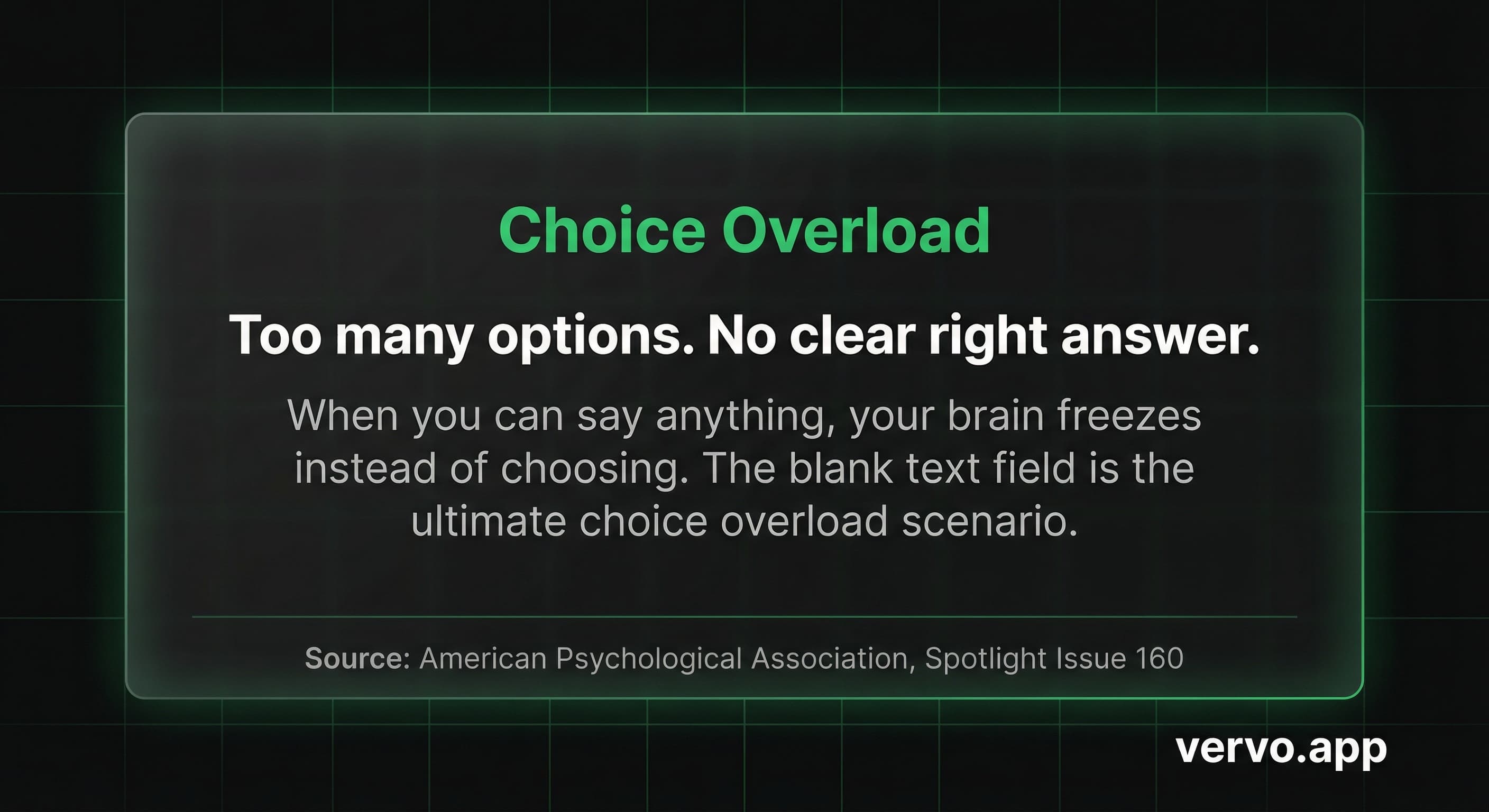
Here's what's actually happening. Research from the American Psychological Association calls it choice overload. When you have too many options with no clear right answer, your brain freezes up instead of choosing. The blank text field is the ultimate choice overload scenario. You could say anything. Which means you end up saying nothing.
Why Does the Blank Text Field Feel So Paralyzing?
It's not that you don't care. It's that you care too much.
When someone shares something heavy -- a loss, a struggle, a complicated situation -- your brain starts running calculations. What do they need to hear? What if I say the wrong thing? What if my words make it worse? What if I come across as fake, or dismissive, or like I'm making it about me?
Those questions multiply until you're frozen. And the longer you stare at the blank field, the worse it gets. Now you're also thinking about how long you've taken to respond. Now the pressure is even higher.
So you do what most people do. You close the app. You tell yourself you'll respond later, when you know what to say. And later turns into tomorrow, and tomorrow turns into a week, and now the silence itself has become the problem.
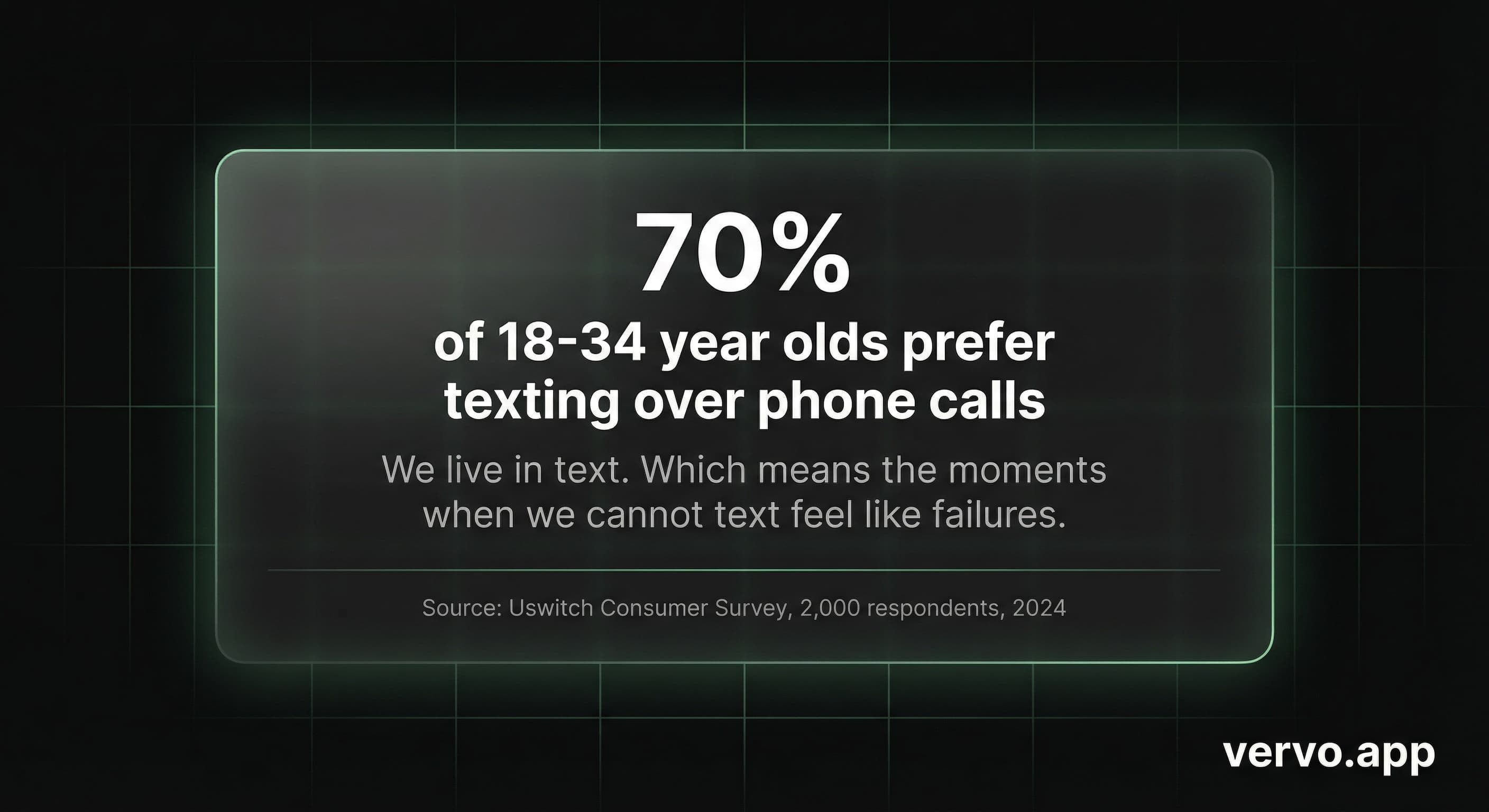
Nearly 70% of people aged 18-34 prefer texting over calling, according to a Uswitch survey. We live in text. Which means the moments when we can't text feel like failures.
What Are the Situations Where People Freeze Most?
Three scenarios come up over and over.
Someone shared bad news. Their parent is sick. They lost their job. A relationship ended. You want to be there for them, but "I'm so sorry" feels inadequate and everything else feels worse.
The relationship is tense. You had a disagreement. Things have been off. You know you should reach out, but you don't know whether to address it directly or pretend everything is normal.
You just met someone. Maybe it's a dating app match. Maybe it's someone you exchanged numbers with. The conversation could go anywhere, and the pressure of a first impression is making every possible opening line feel wrong.
If you've ever overthought a simple text until it stopped being simple, you know exactly what I'm talking about.
How Do I Respond When Someone Shares Bad News?
This is where most people freeze the hardest. Someone tells you their mom has cancer, or their dog died, or they're going through a divorce. And your brain screams what could I possibly say that would help?
Here's the framework: Acknowledge.
You don't have to fix it. You don't have to have the perfect words. You just have to name what happened and show up.
That's it. No advice. No silver linings. No "everything happens for a reason." Just presence.
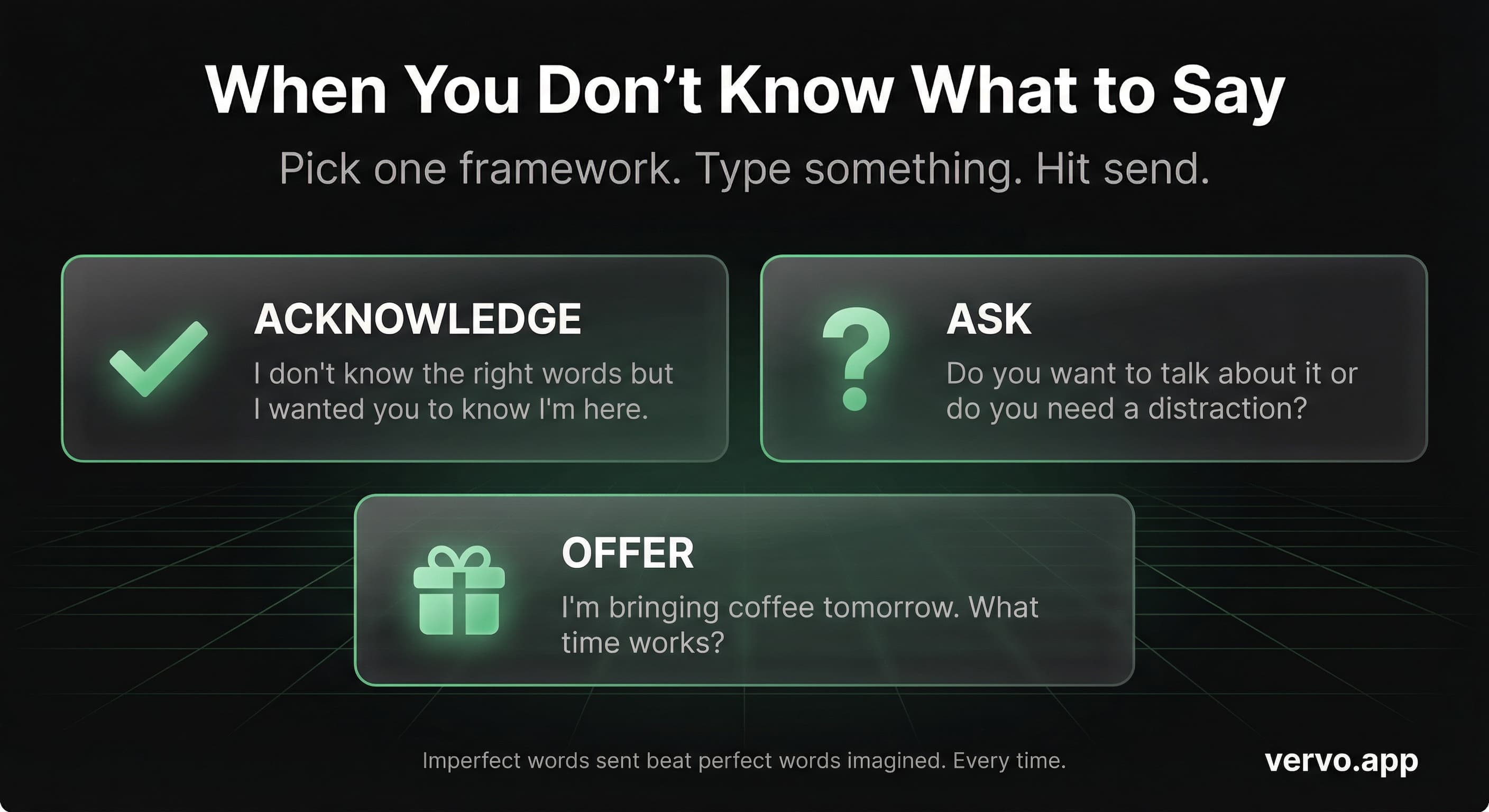
The sentence "I don't know what to say" is a perfectly valid thing to text. It's honest. And it's infinitely better than silence. When someone is struggling and you want to reach out, they're not expecting eloquence. They just want to know you care.
Other versions of Acknowledge:
- "I heard about [the thing]. I'm thinking of you."
- "I don't have the right words but I'm here if you need anything."
- "That's really hard. I'm sorry you're going through this."
What If I Don't Know What They Need?
When you're not sure what would actually help, switch frameworks: Ask.
Asking takes the pressure off you to guess what they need and puts the control back in their hands. Some people want to vent. Some people want distraction. Some people want practical help. You don't have to read their mind.
That "do you want to talk about it or do you need a distraction" line is one of the most useful things I've ever learned to text. It gives them permission to say what they actually need instead of what they think you want to hear.
Other versions of Ask:
- "What do you need right now?"
- "Is there anything I can do?"
- "Do you want company or space?"
This is especially useful when someone is grieving. Grief is unpredictable. Asking beats assuming every time.
What If They Need Something Practical?
Third framework: Offer. And make it specific.
"Let me know if you need anything" is well-intentioned but useless. It puts the burden on them to think of something and then ask for it. Most people won't.
Instead, offer something concrete:
See the difference? "Let me know if you need anything" puts the work on them. "I'm bringing coffee, what time?" puts the work on you. That's the point.
Other versions of Offer:
- "I'm free Saturday if you want to get out of the house."
- "I can pick up groceries. Just text me a list."
- "Want me to come over and we can just sit?"
What About When You Just Met Someone?
New people are a different kind of freeze. It's not about supporting them through something hard. It's about making an impression without sounding try-hard.
The good news: the bar is lower than you think. You don't need to be clever. You just need to be real.
If you're blanking on how to start a text conversation, here's the simple version: reference something specific. Something you talked about. Something from their profile. Something from where you met.
Generic: "Hey, what's up?"
Specific: "Hey, did you ever try that Thai place you mentioned?"
The specific version shows you were paying attention. That's more impressive than any clever opener.
What Do I Do When All Three Frameworks Fail?
Sometimes you try Acknowledge, Ask, and Offer. And you're still staring at a blank screen. The situation is too complicated. The relationship is too loaded. Your brain is too fried.
This is when I screenshot the conversation and let Vervo give me options. Not because I've given up on writing my own words, but because seeing three possible responses in front of me breaks the paralysis. My brain goes from "I have no idea what to say" to "oh, the second one. That's the vibe."
It's the difference between staring at a blank page and choosing from a menu. The choosing is easier.
Does It Have to Be Perfect?
No. And this is the part I wish someone had told me years ago.
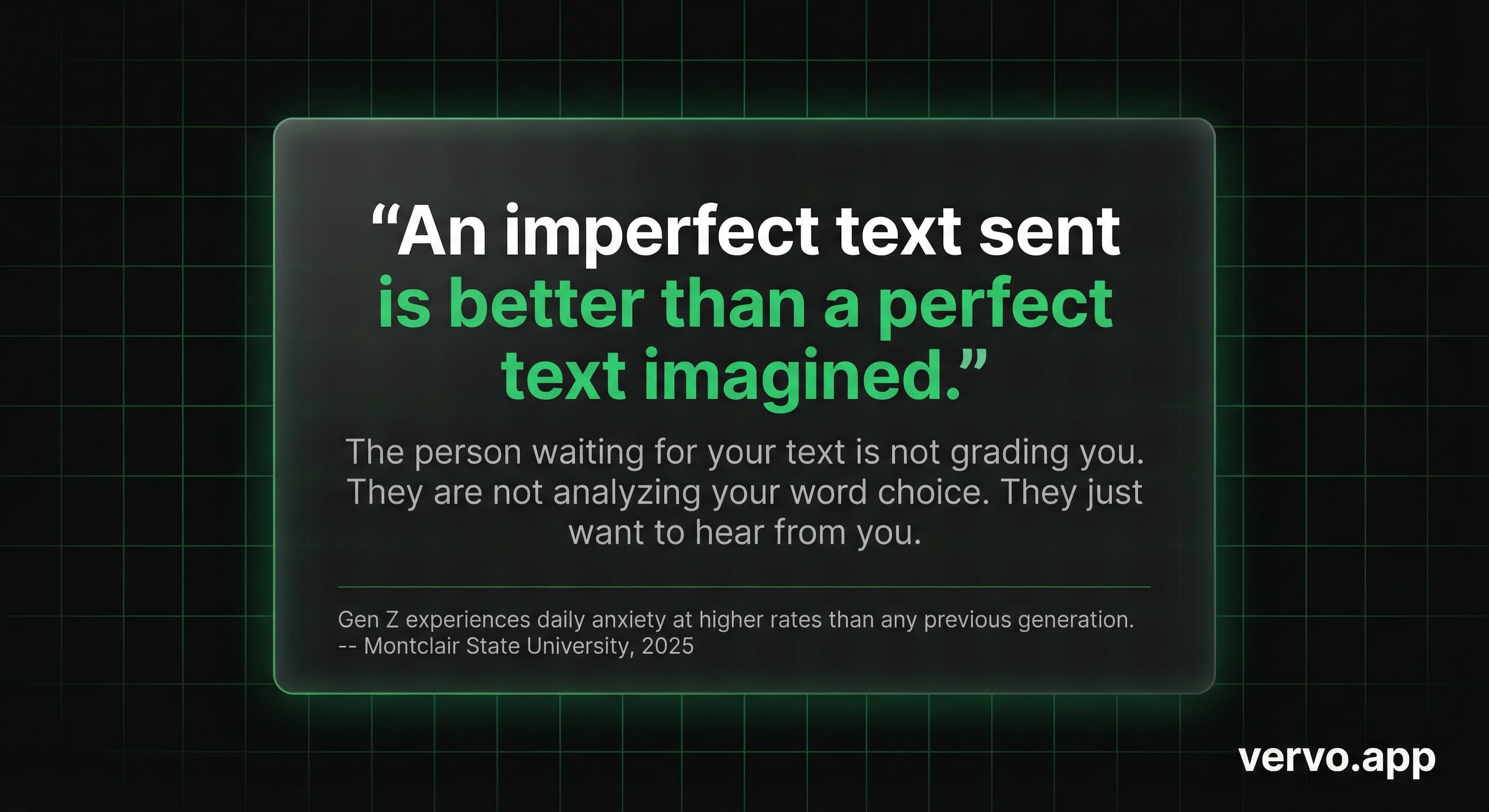
The person waiting for your text isn't grading you. They're not analyzing your word choice. They're not timing how long you took to respond. They're just hoping to hear from you.
Gen Z experiences daily anxiety at higher rates than any previous generation, according to a Montclair State University study. Part of that anxiety is this constant pressure to perform in digital spaces. The pressure to be funny, to be supportive, to be the perfect friend or partner or person, all through a screen. But the people who love you don't want perfection. They want presence.
An imperfect text sent is better than a perfect text imagined. Every time.
The cursor is still blinking. But now you have a framework. Acknowledge, Ask, or Offer. Pick one. Type something. Hit send.
It doesn't have to be perfect. It just has to be something.
Sources
- American Psychological Association, "Choose Quickly or Naught: Paralyzed by a Plethora of Options," APA Spotlight Issue 160
- Uswitch Consumer Survey, 2,000 respondents, 2024
- Montclair State University, "Why Gen Z is More Anxious than Ever," Dr. Yi Luo, Dr. Jin-A Choi, Dr. Bond Benton, 2025