How to Text a Professor (Without Sounding Like You Need a Favor)
Texting a professor should not require 20 minutes of draft-and-delete. Here are the rules, the templates, and the anxiety explained.

You have your professor's number.
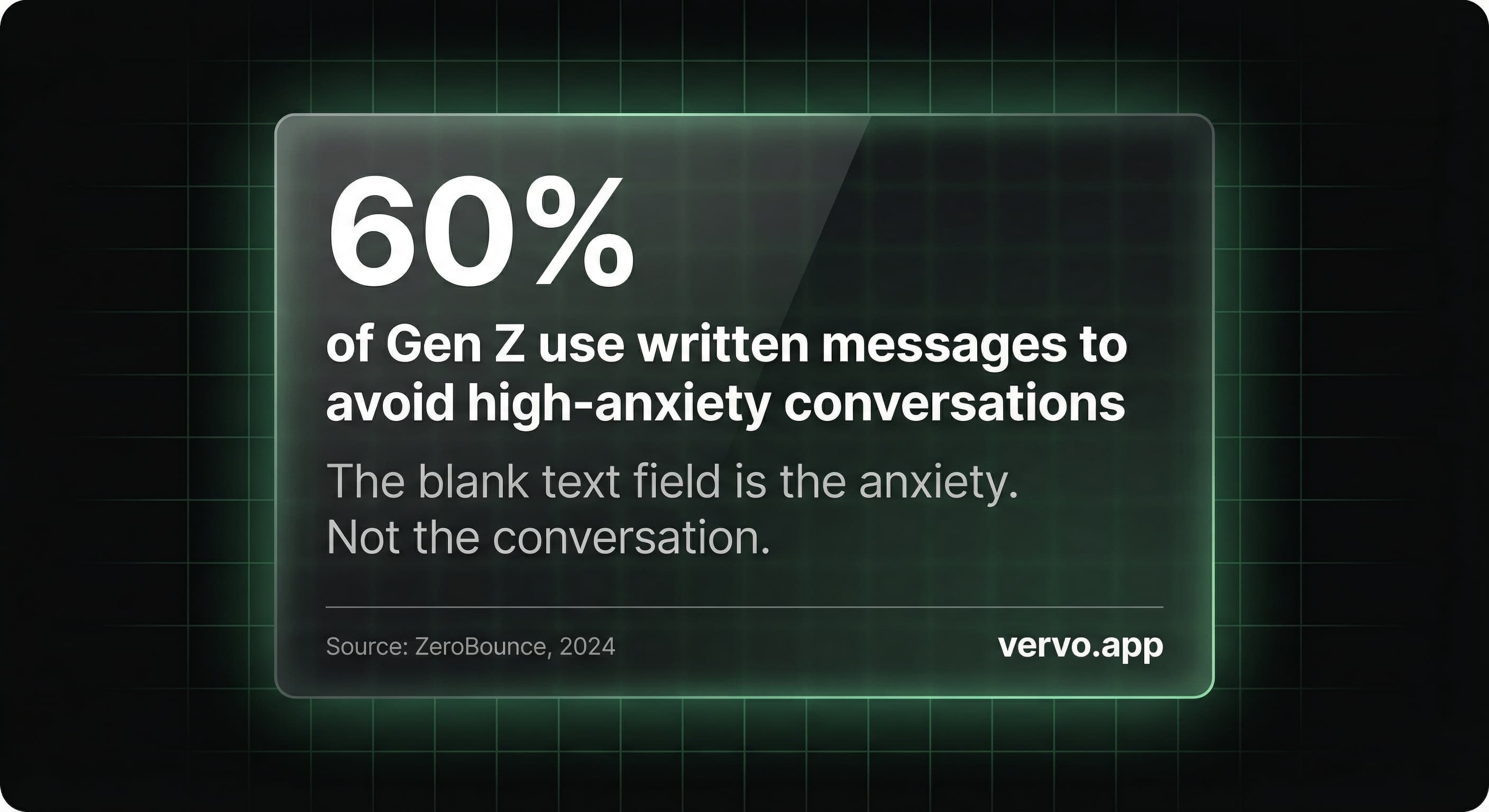
Or you have the LMS message window open. The cursor is blinking. You've typed "Hi Professor" and deleted it three times because it feels weirdly stiff, but "Hey" feels like you're texting a friend who happens to grade your papers.
Twenty minutes. One blank field.
I built vervo.app partly because I spent years in jobs where I had to figure out the right way to say something to someone who had power over me. Kitchens. Call centers. Healthcare. There is always a version of this -- the message to the person who evaluates you, where every word feels like a calculated risk.
Texting a professor is that exact problem, compressed into a phone screen. The good news is there are actual rules for this, and once you know them, the blank-field paralysis mostly goes away.
Should You Text or Email Your Professor?
This is the real first question, and most advice skips it entirely.
Text is appropriate when:
- The professor gave you their number directly, or your institution has an official LMS messaging system (Canvas Inbox, Blackboard Messages, etc.)
- The question is logistical and time-sensitive -- missing class in an hour, confirming a meeting, a quick deadline clarification
- It can be answered in one exchange
Email is correct when:
- You are asking for an extension, disputing a grade, making a formal request, or sending anything that needs a paper trail
- The professor did not give you their number
- The topic requires more than a sentence of context
One firm rule on LMS messages: treat them exactly like email. The interface looks like a text. The tone should not be. A Canvas message that opens with "yo quick question" is an email that opens with "yo quick question."
What Are the Rules for Texting a Professor?
Five rules. Follow all of them.
1. Only text if they invited it. If a professor gave out their number in class or through a syllabus, you have implicit permission to use it for relevant course communication. If you found it somewhere else, use email.
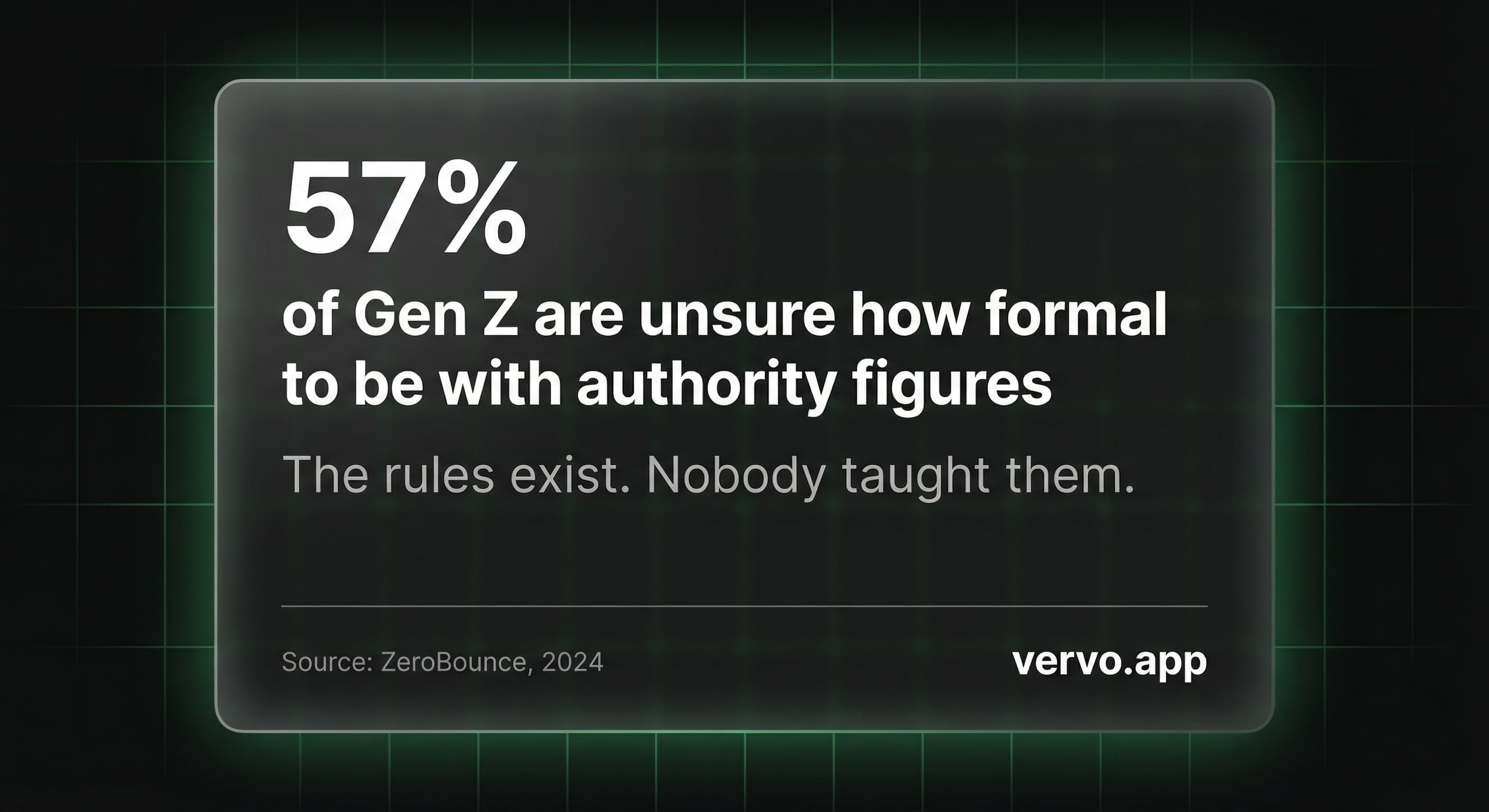
2. Use their title. "Professor" or "Dr." followed by their last name. Not "Hi," not "Hey," not their first name unless they have explicitly told you to use it. That explicit permission needs to come from them, not from a third party who claims it is fine.
3. Identify yourself in the first line. Your professor may have 150 students across four sections. They do not have your number saved. The first line of any text is: your name, the course, and the section. "This is [Name] from your Tuesday 10am BIOL 202 section." Every time. Without this, your message is an anonymous request from a stranger.
4. Lead with the ask, follow with the context. Most people get this backwards. They write three sentences of context and then tack the actual question onto the end. Professors are receiving dozens of messages on any given day. Put the request first: "I wanted to ask about an extension on the research draft." Then give the one-sentence reason. Then close with a specific question.
5. No texts after 9pm or before 8am. Your deadline anxiety is not their emergency. If you realize at 11pm that your paper is due at midnight, that is a personal crisis, not a reason to wake someone's phone. Send it in the morning. Or better, do not be in that situation -- which is a separate conversation.
What Are the Best Texts to Send a Professor?
Copy any of these directly. Swap in your name, class, and details.
Asking about an assignment deadline: "Hi Professor [Name], this is [Your Name] from your Monday 2pm HIST 301 section. I wanted to confirm -- is the annotated bibliography due Friday at 11:59pm or at the start of class? Thank you."
Asking for an extension (non-emergency): "Hi Professor [Name], this is [Your Name] from ENGL 201 Tuesday 10am. I wanted to ask whether a short extension on the essay would be possible. I've had a difficult week and want to turn in work that reflects the course standards. Would 48 hours be feasible? Thank you."
Asking for an extension (genuine emergency): "Hi Professor [Name], this is [Your Name] from PSYC 110 Wednesday 1pm. There has been a family emergency this week. I will not be able to submit the midterm paper on time. I can provide documentation. Would it be possible to discuss options? Thank you."
Reporting an absence before class: "Hi Professor [Name], this is [Your Name] from your Thursday 9am CHEM 201 section. I need to miss today's class -- I'm not feeling well. I'll get the notes from a classmate and catch up on anything I missed."
Reporting an absence after class (same day): "Hi Professor [Name], this is [Your Name] from COMM 150 Tuesday 11am. I had to miss today's class. Could you let me know if there was anything due or any announcements I should be aware of? Thank you."
Asking about office hours: "Hi Professor [Name], this is [Your Name] from MATH 220. I wanted to come to office hours this week to go over the last problem set. Are you available Thursday between 2 and 4? If not, I'm happy to work around your schedule."
Following up after 48 hours with no reply: "Hi Professor [Name], this is [Your Name] -- following up on a message I sent Monday about [topic]. No rush, just wanted to make sure it came through. Thank you."
Clarifying feedback on a graded assignment: "Hi Professor [Name], this is [Your Name] from ECON 301. I received the feedback on my paper and had a question about one comment -- specifically the note on page 3 about my use of sources. Would office hours be a good time to discuss? Thank you."
Asking for a Zoom meeting: "Hi Professor [Name], this is [Your Name] from your MWF SOCL 202 section. Would you be open to a brief Zoom meeting this week to discuss the final project direction? I have a few questions that would be easier to talk through than to write out. Thank you."
Requesting a recommendation letter: "Hi Professor [Name], this is [Your Name] from your fall PHIL 310 seminar. I'm applying to [program] and would be grateful if you would be willing to write a recommendation letter on my behalf. The deadline is [date]. I can send my resume, personal statement, and any other materials you need. Thank you for considering it."
If you are struggling to adapt any of these to your specific situation, that is exactly what a screenshot to reply app is for. Take a screenshot of whatever you have drafted, get three versions back, and pick the one that sounds like a version of you who has your life together.
What Should You Never Text a Professor?
Texting without identifying yourself. They do not know who you are. This is the most common mistake and it makes every request harder to respond to.
Asking something the syllabus already answers. Check the syllabus first. If the answer is there, do not ask. If the syllabus is ambiguous, say so: "I checked the syllabus and it lists Friday but I wanted to confirm." That phrasing shows you did the work.
One-word messages or vague openers. "Hey" as an opening message to a professor is a complete non-starter. You are not setting up a conversation -- you are making a request. Get to it.
Texting to dispute a grade. Grade disputes require email or in-person conversation. They need documentation, a considered response, and a record. A text is the wrong channel for this entirely.
Following up 20 minutes after you sent the original message. Professors are not waiting by their phones for your text. The follow-up rule is 48 weekday hours, minimum.
Using their first name without permission. This signals either that you do not know the professional norm or that you are choosing to ignore it. Neither is a good look at the moment you are asking them for something.
What Should You Do If Your Professor Does Not Respond?
Wait 48 hours on weekdays. Do not count weekends or university holidays against the clock.
If 48 hours pass with no reply, one follow-up is appropriate. Use the template above -- state your name, the class, what you sent, and that you are just confirming it came through. Do not add frustration or urgency to the tone. One follow-up.
If that also gets no reply, go to office hours in person. Some professors have full inboxes and are better reached face to face. Do not send a third text.
The in-person visit is not admitting defeat. It is the correct escalation.
Why Does Texting a Professor Feel So Hard?
Because the stakes are real.
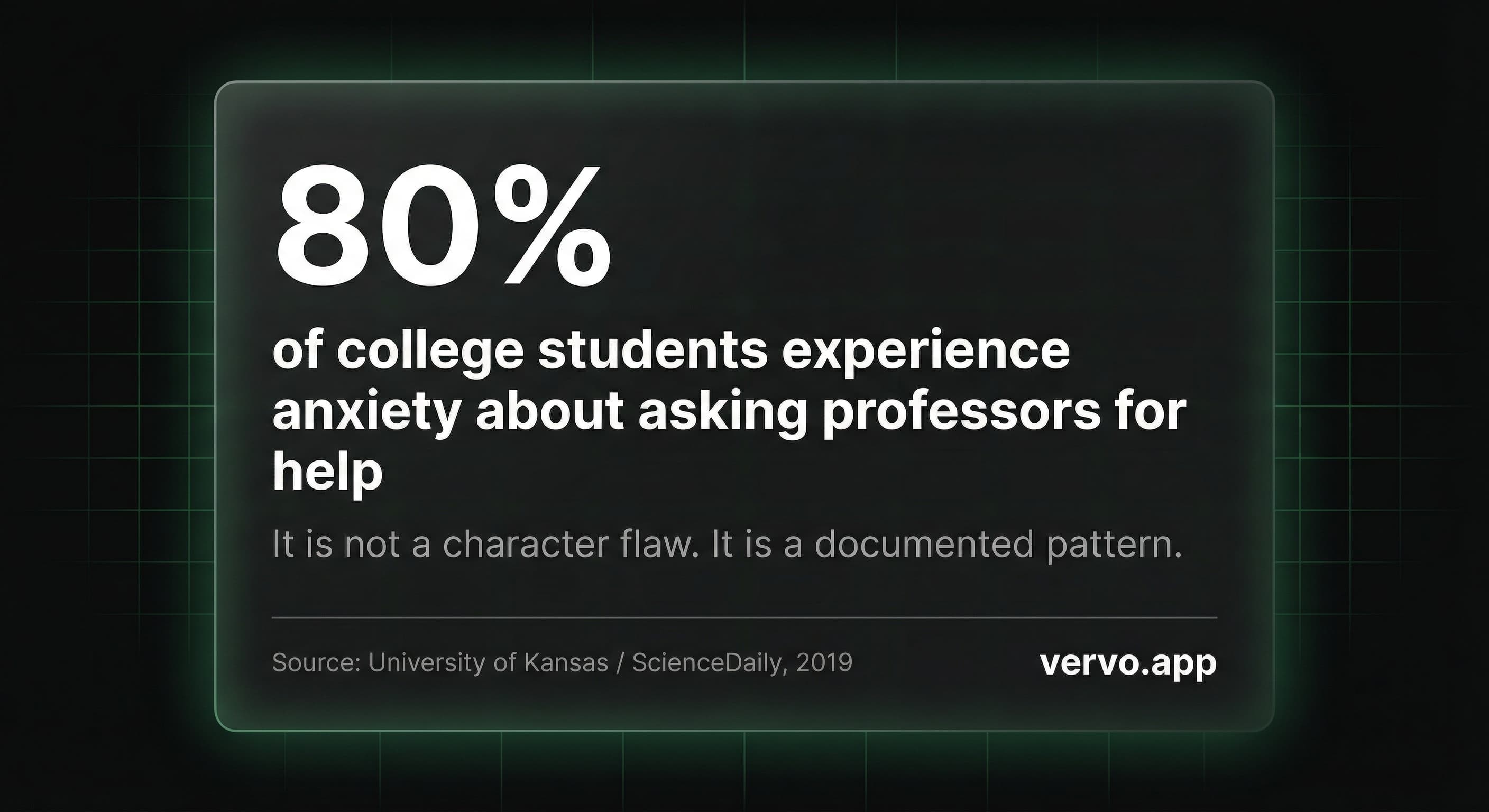
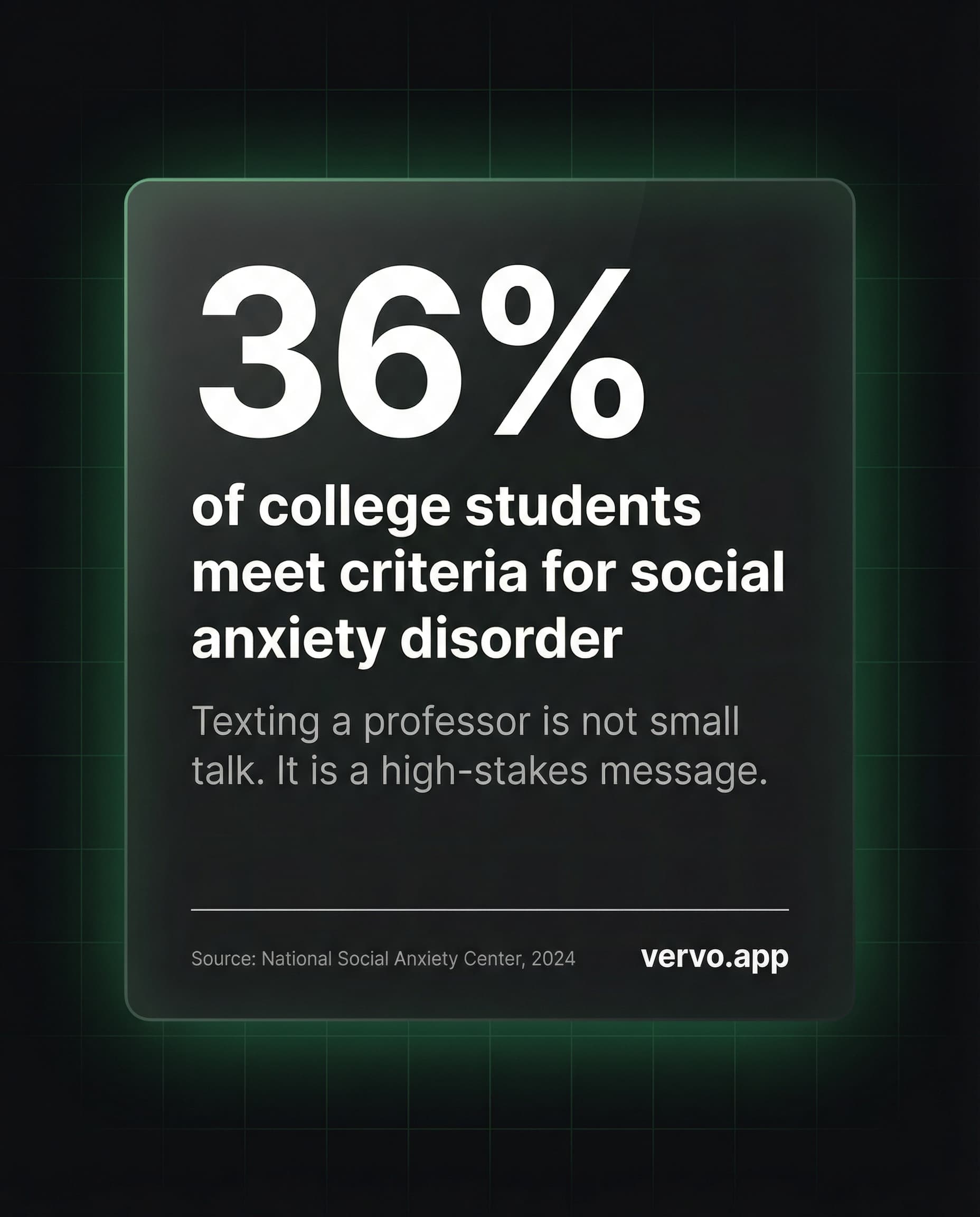
This is not like overthinking texts to a friend where the worst case is awkwardness. Your professor determines your grade. They write your recommendation letters. The power imbalance is not imaginary -- it is the actual structure of the relationship.
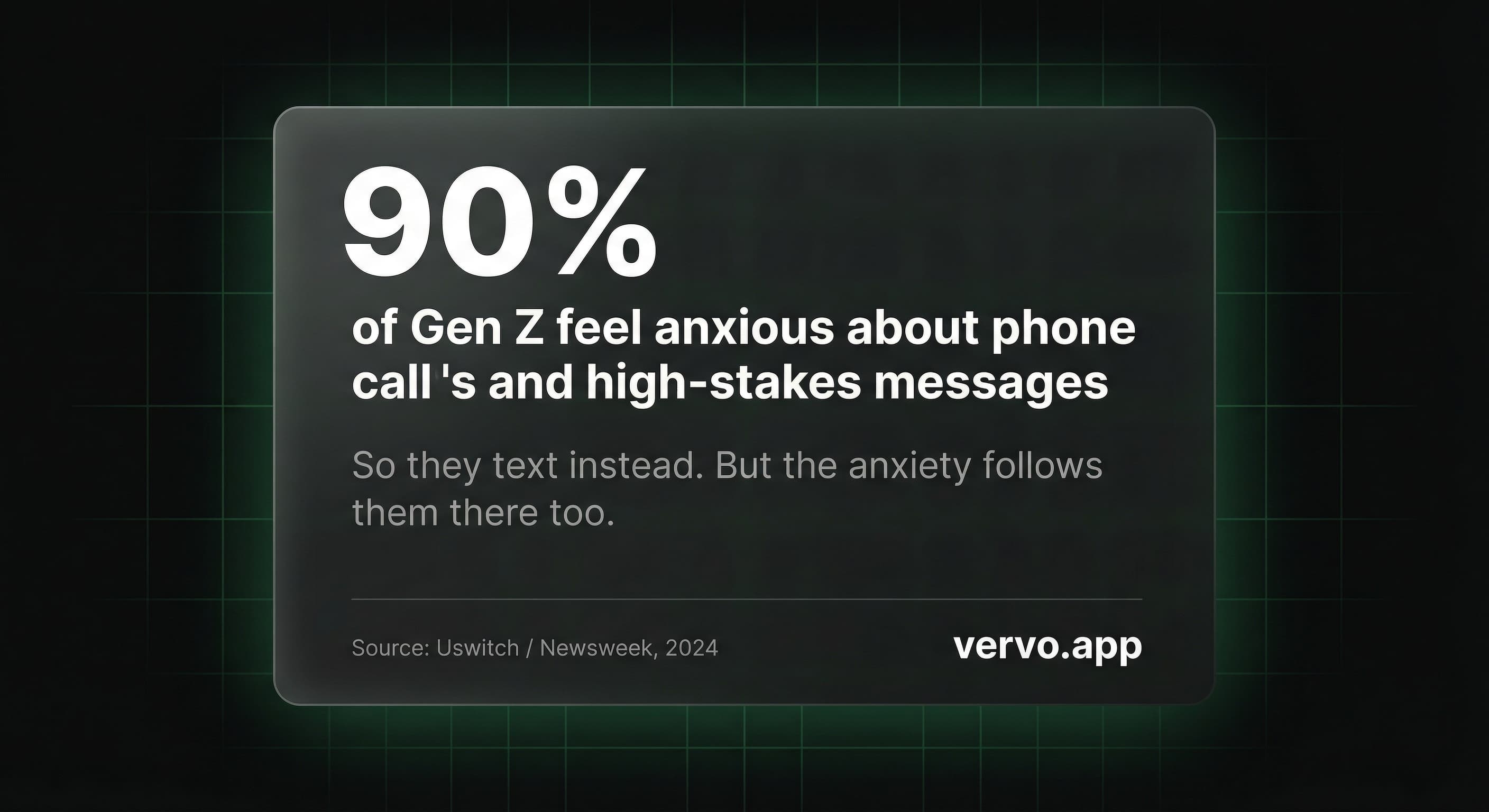
Research across multiple countries consistently shows that 90% of Gen Z feel anxious about high-stakes communication, particularly in situations where they risk being perceived as incompetent or demanding. That is not a character flaw. It is a documented pattern.
The goal when texting a professor is not to sound perfect. The goal is to communicate clearly and professionally. Those are different targets. Perfect is paralyzing. Clear is achievable, and it is all that is actually required.
My daughter is six weeks old. I think about what I want her to know when she is in college, navigating a version of this same moment -- staring at a message field, afraid to ask for what she needs. I want her to know there are rules, and the rules are learnable, and asking for help is not weakness. It is just communication.
That is the whole point.
Sources:
- ZeroBounce Gen Z at Work Report, 2024. zerobounce.net/GenZ-work-report
- ZeroBounce press release, "60% of Gen Z Use Email to Avoid Conflict and Anxiety at Work." zerobounce.net/blog/newsroom/press/gen-z-email-avoid-conflict-work-zerobounce-survey
- National Social Anxiety Center, "Social Anxiety in Generation Z," 2024. nationalsocialanxietycenter.com
- AmberWillo, Social Anxiety Statistics. amberwillo.com/social-anxiety/statistics
- University of Kansas / ScienceDaily, "Statistics Anxiety Is Real," January 2019. sciencedaily.com
- Uswitch, 2024 UK research cited in Newsweek, "How Phone Anxiety Divides Generations." newsweek.com
- CNBC, "Gen Z Are Taking Telephobia Courses," February 2025. cnbc.com