What Is a Screenshot to Reply App? (And Why You Already Know How to Use One)
A screenshot to reply app reads your conversation photo and generates reply options. Here's how they work, who they're for, and how Vervo stacks up.
You got a text that stumped you.
So you did what everyone does. You screenshotted it. You sent it to the group chat. You waited for someone to read the subtext, decode the tone, and tell you what to say back.
My daughter is six weeks old. My group chat response time is not what it used to be. So I started thinking: what if you could skip the group chat?
That's the whole idea behind a screenshot to reply app. Screenshot the conversation. Upload it somewhere. Get reply options back. No retyping. No summarizing context to a chatbot. No waiting for your friends to finish whatever they're doing.
Here's how it works, what makes it different from everything else out there, and who it's actually for.
What is a screenshot to reply app?
It's exactly what it sounds like. You take a screenshot of a text conversation -- any conversation, on any platform -- and upload it to the app. The app reads the screenshot using image recognition, understands the context of the conversation, and generates reply options for you.
The key word is screenshot. You're not retyping anything. You're not summarizing the situation. You're showing it the actual conversation, the same way you'd show your friend your phone.
Right now, Vervo is the only web-based screenshot to reply app. No download. No app store. No keyboard replacement. You go to vervo.app, upload your screenshot, and get three reply options in under a minute. That's the whole flow.
How does it work?
Three steps.
Step 1: Take a screenshot. Any conversation. iMessage, WhatsApp, Instagram DMs, Slack, Gmail, a photo of a Post-it note someone left on your desk. If you can photograph it, Vervo can read it.
Step 2: Upload the screenshot. Drag it in or tap to upload at vervo.app. That's it. No account required for the first five.
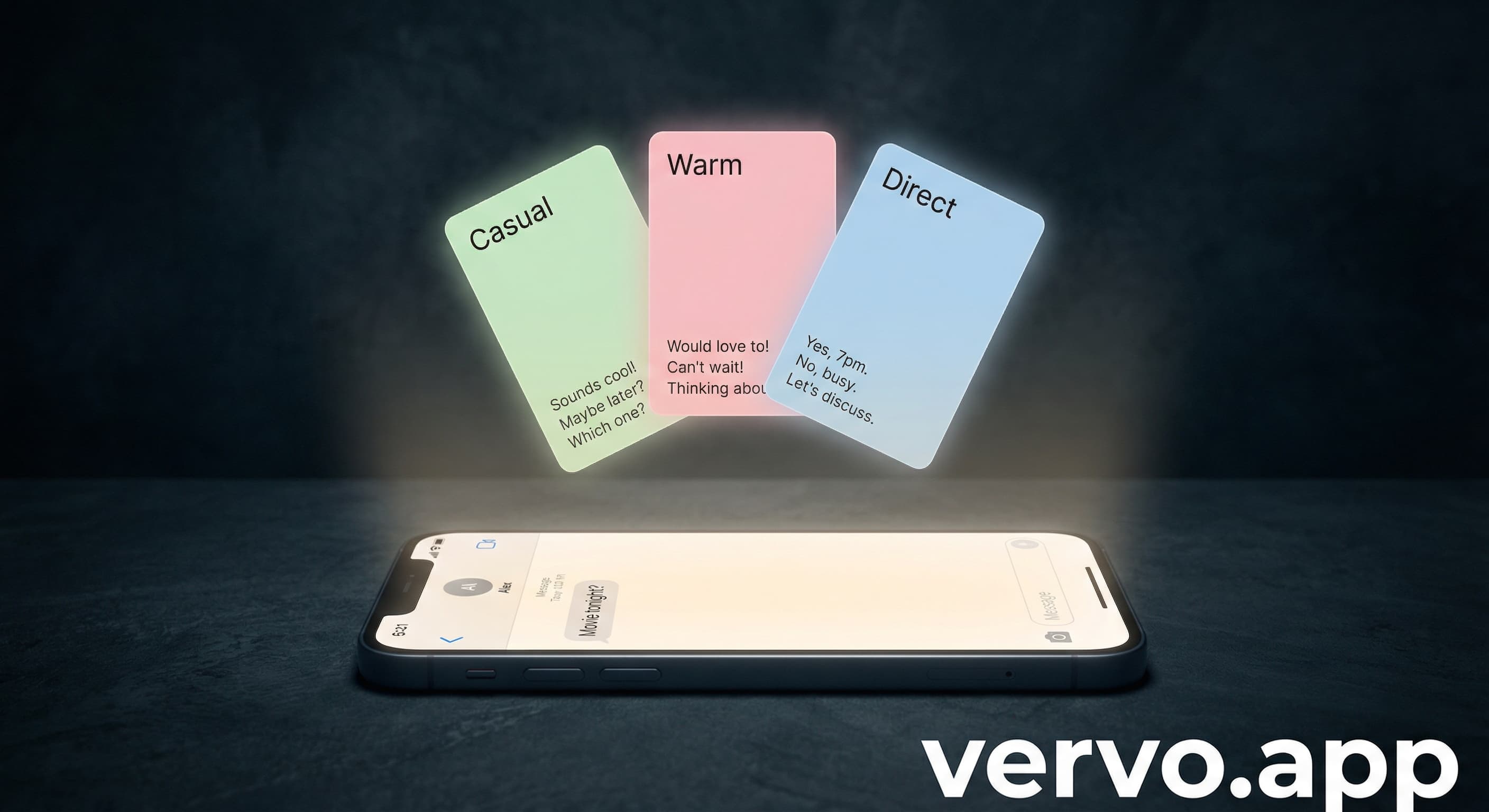
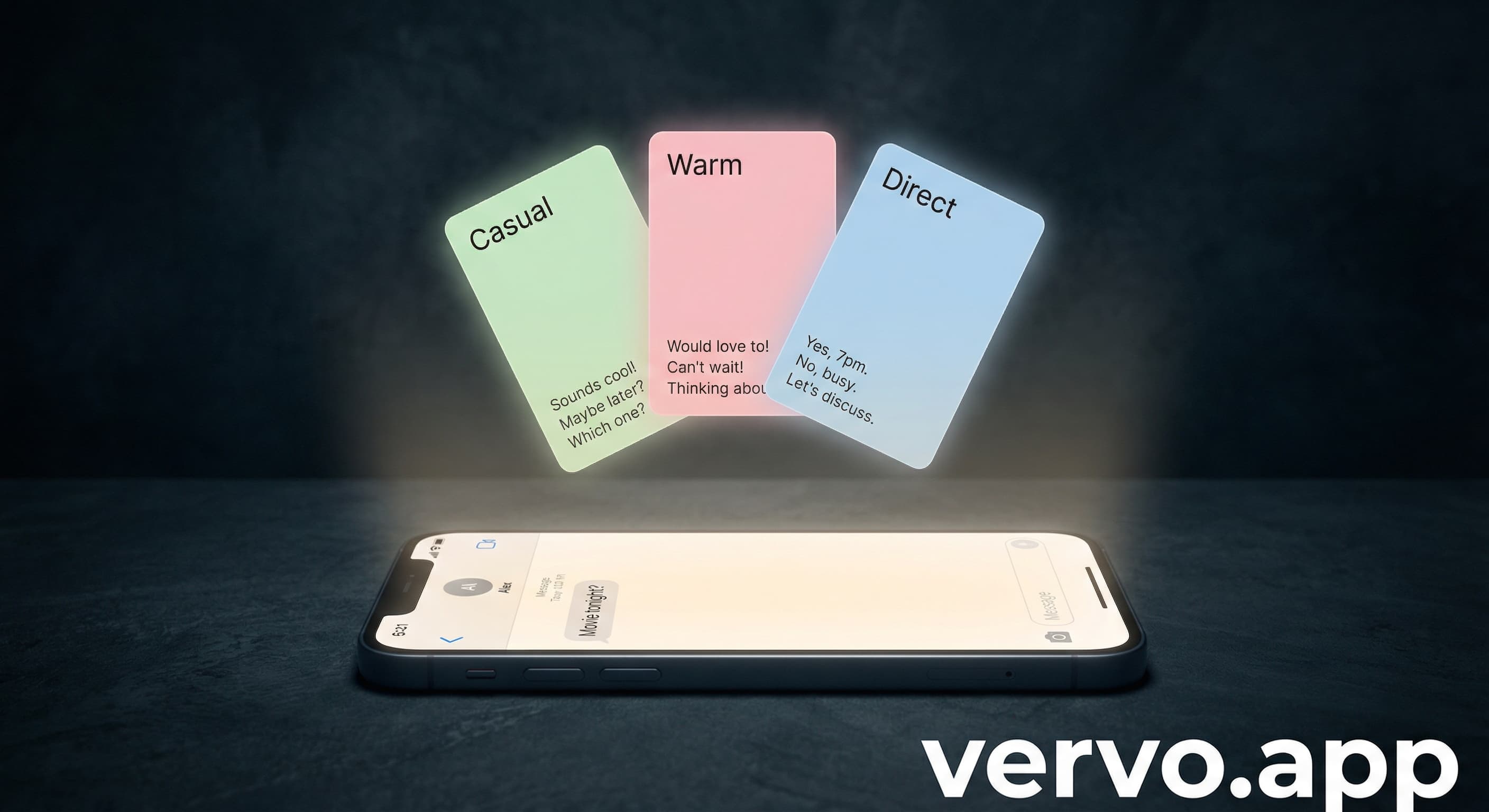
Step 3: Pick a reply. You get three options in three tones. Casual (lighter, funny, low-stakes energy). Warm (thoughtful, emotionally attuned). Direct (clear, efficient, no ambiguity). Each reply comes with a short explanation of why it works -- what it's doing strategically so the conversation goes where you want it to go.
That last part matters. Most tools just give you the fish. Vervo shows you why that particular fish works for that particular river. You learn something every time you use it.
Why not just use ChatGPT?
Tried it. It's not the same thing.
With ChatGPT, you have to type the whole conversation into the chat window. Accurately. In the right order. With enough context that the model understands what's going on. If the conversation is long or emotionally loaded, that's a ten-minute project before you've even started. And then you have to explain things like your history with this person, their communication style, what you actually want from the exchange.
Vervo reads the screenshot. You don't type anything. The context is already there.
The other difference: ChatGPT gives you one answer. One tone. One angle. If it's wrong for the situation, you're back to the blank text field. Vervo gives you three, in different tones, so you can pick the one that actually sounds like you.
And ChatGPT does not explain why. It writes a reply and hands it to you. Vervo tells you why the casual option is disarming in this specific moment, or why the direct option is less likely to start a fight. That framing is what turns it from a text generator into something that actually makes you better at communicating.
How is it different from Rizz or other AI dating apps?
The dating apps are good at one thing: dating app conversations.
Rizz, YourMove, Plug AI. They were all built for a specific use case -- you matched with someone, the conversation stalled, you need a witty opener. For that narrow problem, they work fine.
The issues start everywhere else. Your boss sent a 10pm "quick question." Your friend is going through a breakup and you don't know what to say. Your landlord texted something passive-aggressive about the noise. The passive-aggressive tone detector in your brain is firing, you know something is off, but you can't find the right response. None of the dating apps help with any of that. They're not built for it.
Vervo handles all of it. Dating, yes. But also work texts, family texts, difficult conversations with friends, logistical awkwardness, anything where you know what you want to say but can't figure out how to say it.
The other differences aren't small. Dating apps are mostly mobile-only. Several of them require you to download an app and grant keyboard access -- meaning a third-party AI is reading everything you type, in every app, all the time. Pricing runs from $7 to $28 a month, some of it weekly, with very limited free tiers.
Vervo is a website. No download. No keyboard access. Screenshots are processed and not stored. Five free replies per day. $9.99 a month if you want more.
Who is it actually for?
Four types of people use it regularly.
The anxious texter. You know how to write. You are perfectly capable of forming sentences. But something about certain conversations makes your brain lock up. You rewrite the same reply eleven times. You ask three people for their opinions. You feel relief when someone just tells you what to say. That's the core use case. Vervo is a circuit breaker for the overthinking loop.
The active dater. You're on three apps. You have twelve conversations going. Some of them are interesting and some of them have been "hey" for four days. You need to move conversations forward without spending an hour per match. You also care about what your texting style says about you -- you want replies that feel like you, not a template.
The young professional. You can write a report. You can give a presentation. But texting your boss feels like defusing a bomb. Texting a coworker about something uncomfortable feels worse. You want to sound confident without sounding aggressive, helpful without being a pushover, and professional without being robotic. Tone is everything and you never quite know which one to use.
The content creator. You're managing a brand account or a community and you get DMs constantly. Some of them need genuine responses, not copy-paste. You need to sound human and fast, not like an autoresponder. Vervo gives you a starting point that sounds like a real person wrote it.
None of these people are bad at communicating. They're just in situations where the right words don't come automatically. That's most of us, most of the time.
Does it actually work?
Honest answer: it depends on what you mean by work.
If you mean "will it write a perfect reply I can send without editing" -- sometimes. The serious tone on a work text is usually ready to go. The casual tone sometimes tries a little too hard and needs a word changed. You still need to read it before you send it.
If you mean "will it get me unstuck when I'm frozen" -- yes. Consistently. The value isn't the magic reply. It's the reset. You see three options and your brain stops spinning. You go "not that one, not that one, but this one with a tweak" and you're done. What took forty minutes now takes ninety seconds.
That's the real product. Not a text generator. A way to break the paralysis.
Five replies a day, free. No credit card. vervo.app.