How to Respond to Boss Text After Hours (Scripts for Every Situation)
Your boss just texted at 10 PM. Here's exactly what to text back -- copy-paste scripts for urgent, non-urgent, and boundary-setting situations.
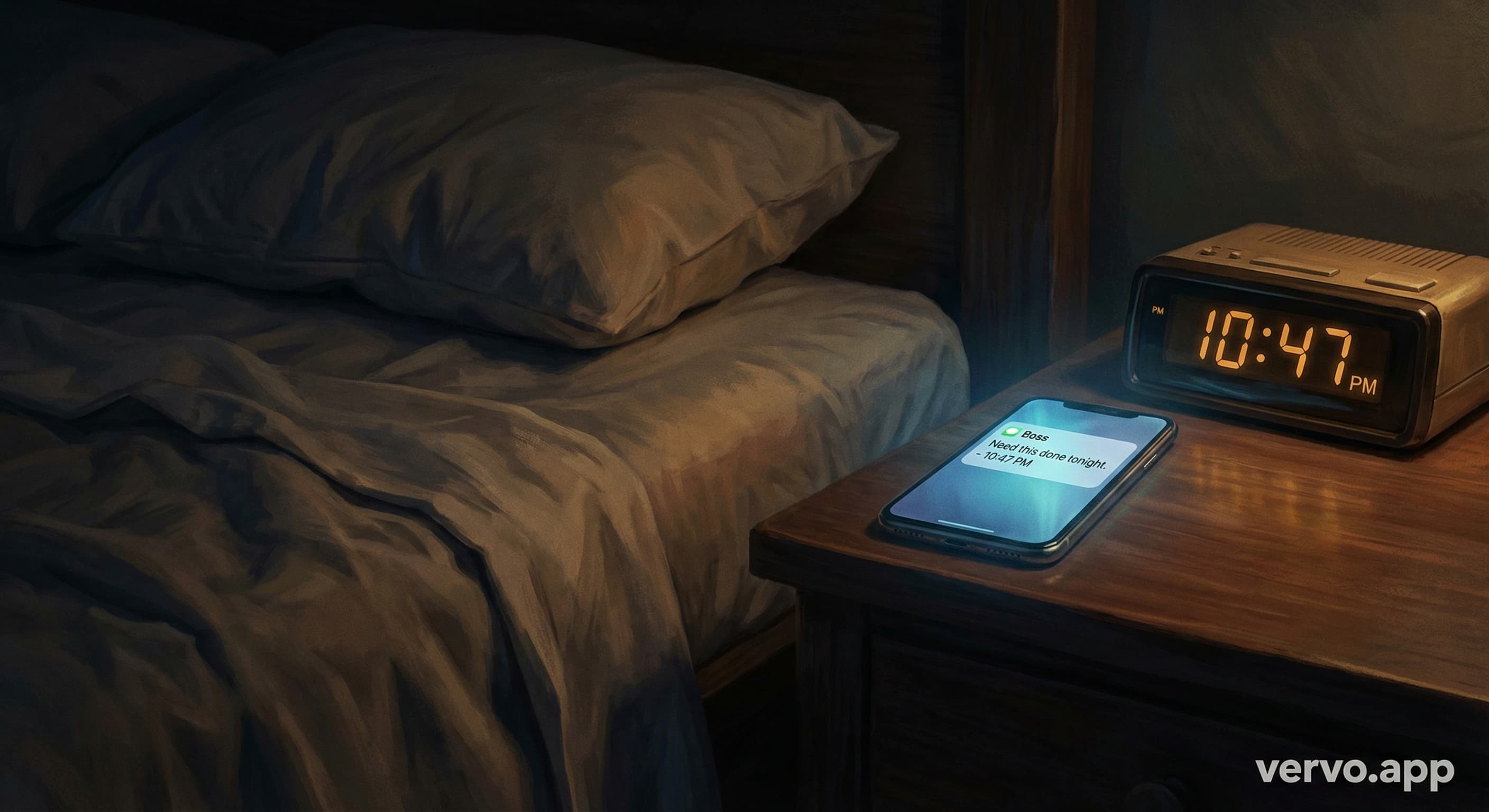
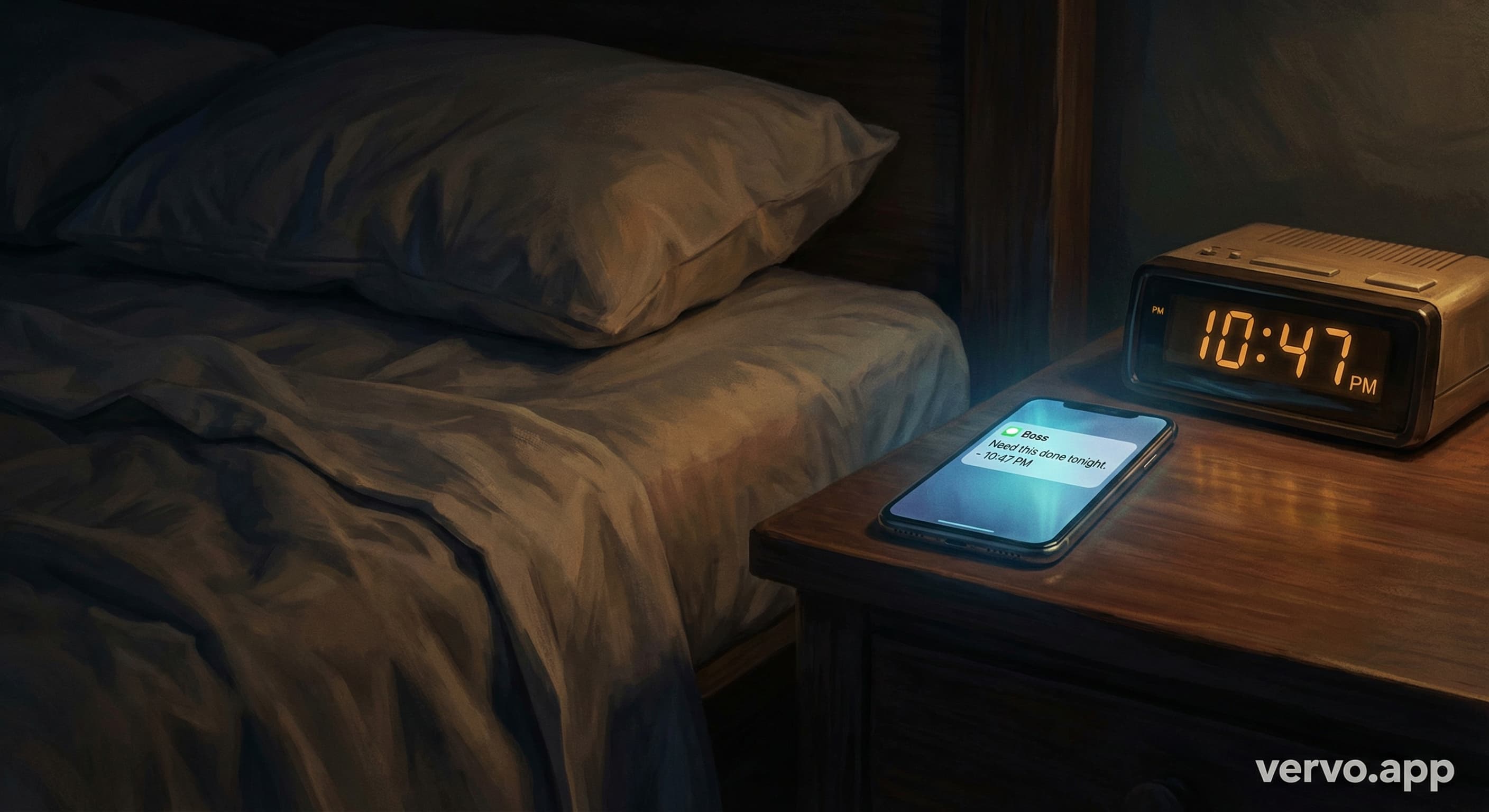
Your boss texted at 10 PM. Your heart rate just went up. You have that low-level dread that only comes from a work notification at the exact moment you were finally relaxing.
Now you're spiraling. Do you respond now? Do you wait until morning? What if ignoring it makes things worse? What if responding sets a precedent you'll regret?
Here's what you actually need. Not theory. Scripts.
Should you respond to your boss after hours?
Not always. But the answer depends on what the text actually is. Before you type a single word, sort it into one of three categories.
Urgent. The server is down. A client presentation moved to 7 AM. Someone is locked out of a system that needs to be live in the next twelve hours. Urgent texts have specific time pressure built into them. They are rare. You can usually tell because the consequence of waiting until morning is concrete and significant.
Non-urgent. Questions about tomorrow's meeting. A status check. A file request. A thought your boss had at 9:45 PM while watching TV. These feel urgent because they're from your boss. They are not. They could wait until morning without anything meaningful breaking.
Boundary-testing. The third category is trickier. It's when after-hours texts happen regularly, when they expect quick replies, when they get followed up with "did you see my message?" These are not just bad timing. They're a pattern. And a pattern needs a different kind of response.
Each category gets different handling.
What do you actually text back?
Here are 10 copy-paste templates organized by what you're dealing with.
Acknowledging without committing
Use this for non-urgent texts when you want to acknowledge you saw it without promising to do the work tonight.
"Got it. I'll look at this first thing tomorrow morning."
"Saw this. I'll pick it up at 8 AM and have something to you by mid-morning."
"Thanks for the heads up. I'll tackle this when I'm at my desk tomorrow."
These are honest, professional, and set a clear expectation. You're not ignoring the message. You're also not opening your laptop at 10 PM for something that can wait.
Declining politely
Use this when you need to be more explicit about being offline.
"I'm offline for the evening but I'll prioritize this at 9 AM. If it's time-sensitive tonight, let me know and I'll figure something out."
"I've signed off for the day but I'll make this the first thing I handle in the morning."
The second sentence matters. It signals you're not dismissing them. You're setting a clear time.
Urgent situations
When it actually is urgent, respond fast and contain the scope.
"On it. I can handle [specific part] tonight. Will update you by [time]."
"Got it. Give me 30 minutes. I'll send you what I have by 10:45."
"I can pull that file right now. Sending in a minute."
Containing the scope is the key move here. "I can handle X" is better than "I can handle everything." It tells your boss what to expect and keeps you from working until midnight on something that only needed twenty minutes.
Setting a boundary
Use this when you want to decline without making it a confrontation.
"I want to give this the attention it deserves. I'll tackle it fresh in the morning with a clear head."
"I'd rather do this properly than rush it tonight. You'll have it by [time] tomorrow."
Both frame the boundary as being in your boss's interest. You're not saying you don't want to work. You're saying you want to do good work. Most reasonable managers hear that differently than "I don't want to deal with this."
The cool boss scenario
Sometimes your boss is genuinely just passing something along and not expecting an immediate response. They have notifications on. They had a thought. They sent it.
"Thanks for the heads up. I'll handle it first thing tomorrow."
That's it. Short, warm, done. No explanation needed.
What if it keeps happening?
One after-hours text is bad timing. A pattern of them is a different problem.
First, document it. If you're being routinely contacted after hours and you're hourly, this matters legally. Under the Fair Labor Standards Act, responding to work texts outside your scheduled hours can qualify as compensable time. Your employer may owe you for it. Several states go further with their own interpretations. The right to disconnect conversation is also worth having before resentment builds up.
Second, handle the pattern in person. Not over text. Not at 10 PM. Bring it up during a one-on-one, when nobody is stressed, and frame it around your output rather than your personal time.
Script: "I've noticed I work better when I can fully recharge in the evenings. I'm going to start muting work notifications after 7 PM. If something is truly urgent, a call is the best way to reach me. Otherwise I'll pick everything up first thing."
That's it. You're telling them what you're doing, not asking permission. You're giving them an escalation path for real emergencies. And you're framing it as performance, not preference.
Third, know the escalation options. If the conversation doesn't change anything, that's information too. A manager who hears that request and doubles down on after-hours texts is showing you something about the culture. That may be worth factoring into longer-term decisions.
How do you set texting boundaries with your boss without sounding difficult?
The framing is almost everything here. There's a big difference between these two approaches.
Version A: "I need you to stop texting me after hours." Version B: "I'm going to protect my evenings so I come in sharp. Here's how to reach me for real emergencies."
Version A puts your boss on the defensive. Version B hands them a system. Same boundary. Completely different dynamic.
Specific language that works:
"I do my best work when I've had time to reset. I'm going to be offline evenings, but I'll make your priorities the first things I tackle every morning."
"Let's try routing after-hours thoughts to email. I'll have it open first thing and can give it proper focus instead of a half-asleep response at 10 PM."
"I want to be fully present during the workday. That means protecting the evenings so I actually can be."
The common thread: you're not asking for less work. You're asking for conditions that produce better work. That's hard for a reasonable manager to argue with. And if they do argue with it, again, that's information.
If you have a strong enough relationship, you can be even more direct. Some bosses genuinely don't realize how their timing lands. A casual mention -- "hey, I tend to read texts right away, so late ones kind of pull me back into work mode, any chance you could email those?" -- often solves it in thirty seconds with no drama.
Check out the full breakdown on texting your boss professionally for more scripts across different workplace situations.
One more thing
If you're staring at a boss text right now and can't figure out what to say -- the one that's professional without being a pushover, responsive without inviting a habit -- screenshot it and upload it to vervo.app. You'll get three reply options across different tones in about ten seconds. Sometimes you just need to see the options written out before you know which one is right.
The text isn't the hard part. The hard part is the thirty-second panic before you decide whether your evening is still yours.
Most of the time, it is.