How to Set Boundaries Over Text (Scripts That Actually Work)
Saying no over text feels impossible when you hate conflict. Here are copy-paste scripts for every awkward boundary you need to set.

Your coworker just texted asking if you can cover her shift. Again. Third time this month.
You want to say no. You know you should say no. You're already exhausted and this is supposed to be your one day off.
But your thumbs are already typing "yeah I can probably make it work" because saying no over text feels mean. Cold. Like you're being difficult. Like they'll screenshot it and show their friends and everyone will agree that you're the worst.
So you say yes. Again. And then you spend the next six hours resenting them, resenting yourself, and swearing that next time will be different.
Next time is never different.
Why Is Saying No Over Text So Hard?
In person, you have tone. You have facial expressions. You can say "I can't this time" with a warm smile and a shrug and they get it -- no hard feelings, just life. The human stuff softens the no.
Text strips all that away. All they see is words on a screen. And without the warmth of your voice or the apologetic tilt of your head, "I can't" reads like "I won't." The same sentence that would land fine in person feels harsh, final, cold.
So you overcorrect. You add qualifiers. You apologize three times. You explain your entire schedule in detail so they understand you're not just being selfish. And by the time you've written a four-paragraph justification for why you can't grab coffee on Saturday, you've already agreed to grab coffee on Saturday.
If you've ever found yourself overthinking every text you send, boundaries are where that overthinking becomes actively destructive. You edit the no into a maybe. Then the maybe into a yes. And they never even knew you were struggling.
What Does a Good Text Boundary Actually Sound Like?
Here's the formula that works. I call it the sandwich -- kind, firm, kind.
Kind: Start with something warm. Acknowledge them. Show you're not dismissing the ask out of hand.
Firm: State the boundary. Clear. Direct. One sentence. No hedging, no "I think I might not be able to," no leaving the door open for negotiation.
Kind: End with something that maintains the relationship. You're saying no to the request, not no to them as a person.
That's it. Three parts. Let's see it in action.
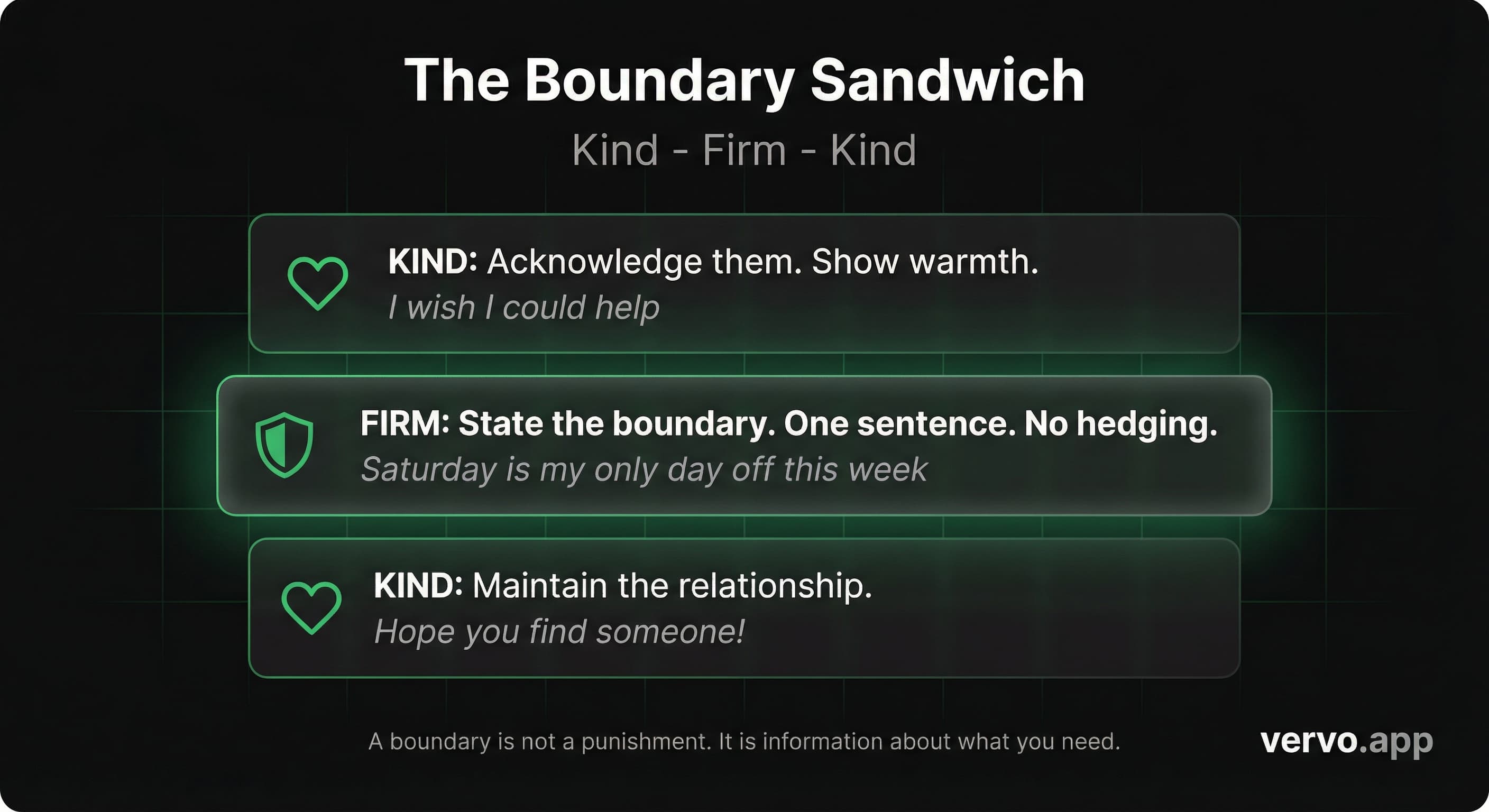
Kind: "I wish I could help." Firm: "Saturday's the one day I have family stuff." Kind: "Hope you find someone."
Notice what's missing: no apology, no elaborate excuse, no offer to help in some other way that you'll also resent. Just a clear no wrapped in enough warmth that the relationship stays intact.
What About When They Push Back?
This is where most people crumble. You set the boundary. They push. And suddenly you're back to explaining yourself, negotiating, or caving entirely because the discomfort of holding the line feels worse than just giving in.
Here's the move: repeat the boundary in different words, then stop responding.
You're not arguing. You're not defending. You're restating the boundary in slightly different language and then you're done. If they keep pushing after that, your silence is the response.
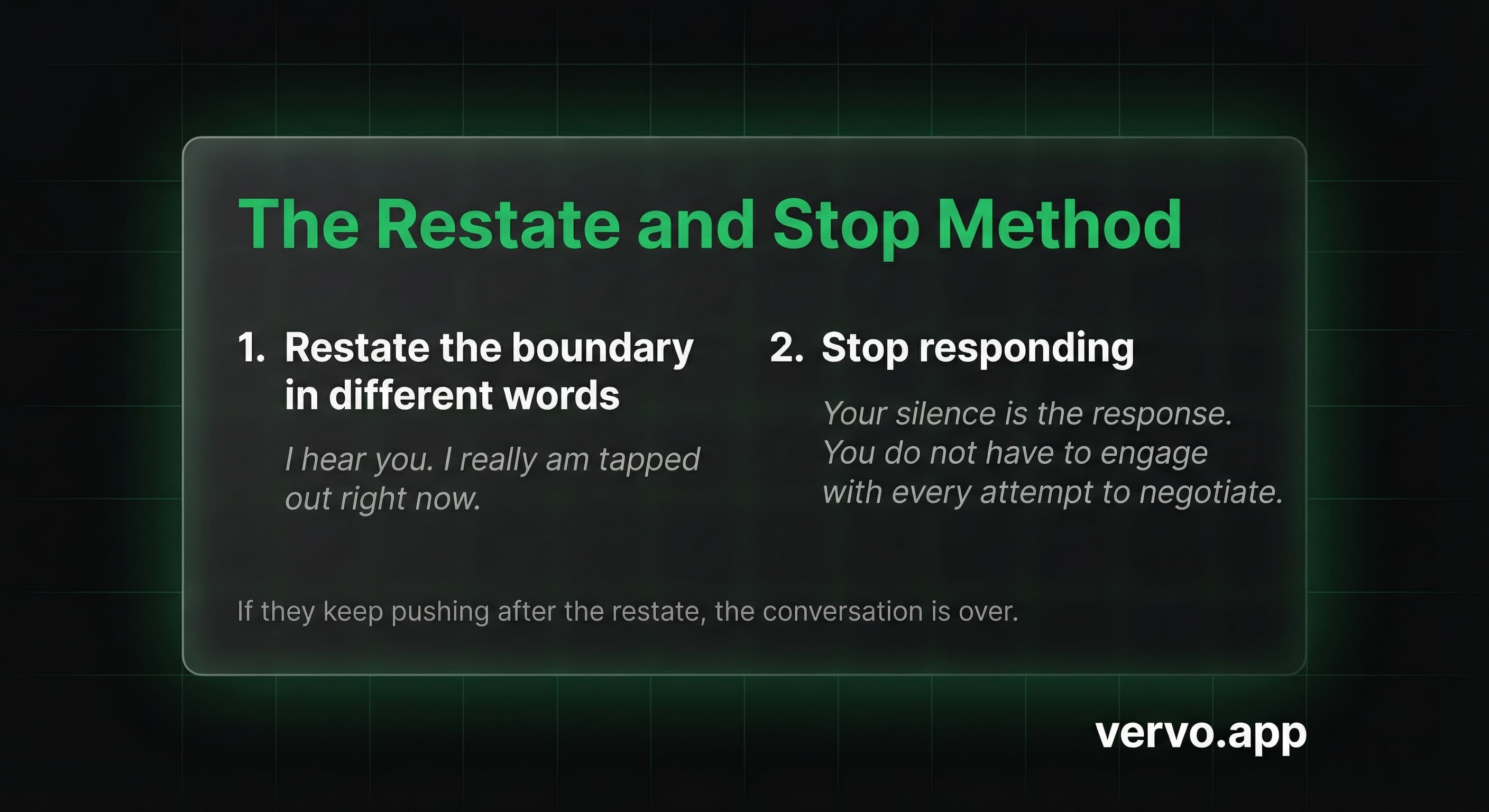
The delayed reply -- or no reply at all -- is itself a boundary. You don't have to engage with every attempt to negotiate. Knowing when to stop replying is half the battle.
Scripts for the Hard Ones
Let me give you some copy-paste options for the boundaries people struggle with most.
Boss texting after hours
No apology. No explanation about what you're doing tonight. Just a redirect to when you'll actually be working.
Friend who always cancels and reschedules
This one's subtle. You're not making the next plan. You're putting the ball in her court. If she wants to see you, she can do the work of finding a time that sticks.
Family member who overshares or guilt-trips
Don't engage with the guilt. Don't defend yourself. State what you will do, not what you won't.
Ex who keeps reaching out
Clear. Final. No door left open for "what do you mean by space" or "can we at least be friends." If the conversation needs to end entirely, you're allowed to end it.
Coworker who dumps work on you
Notice: not "I can't" which invites negotiation. "You'll want to check with someone else" redirects without apology.
Why Short Boundaries Land Better
Your instinct when setting a boundary is to explain. To justify. To make them understand why this particular ask is too much for you right now given everything else going on in your life and your schedule and your mental state and --
Stop.
Long explanations do two things. First, they give the other person material to argue with. Every reason you provide is a reason they can counter. "You said you're tired but you posted on Instagram last night." "You said you're busy but that was three days from now."
Second, long explanations signal that you don't believe your no is valid on its own. That you need their permission to have a boundary. That the boundary only counts if they agree with your reasoning.
You don't need their permission. "I can't" is a complete sentence. So is "That doesn't work for me." So is "No."
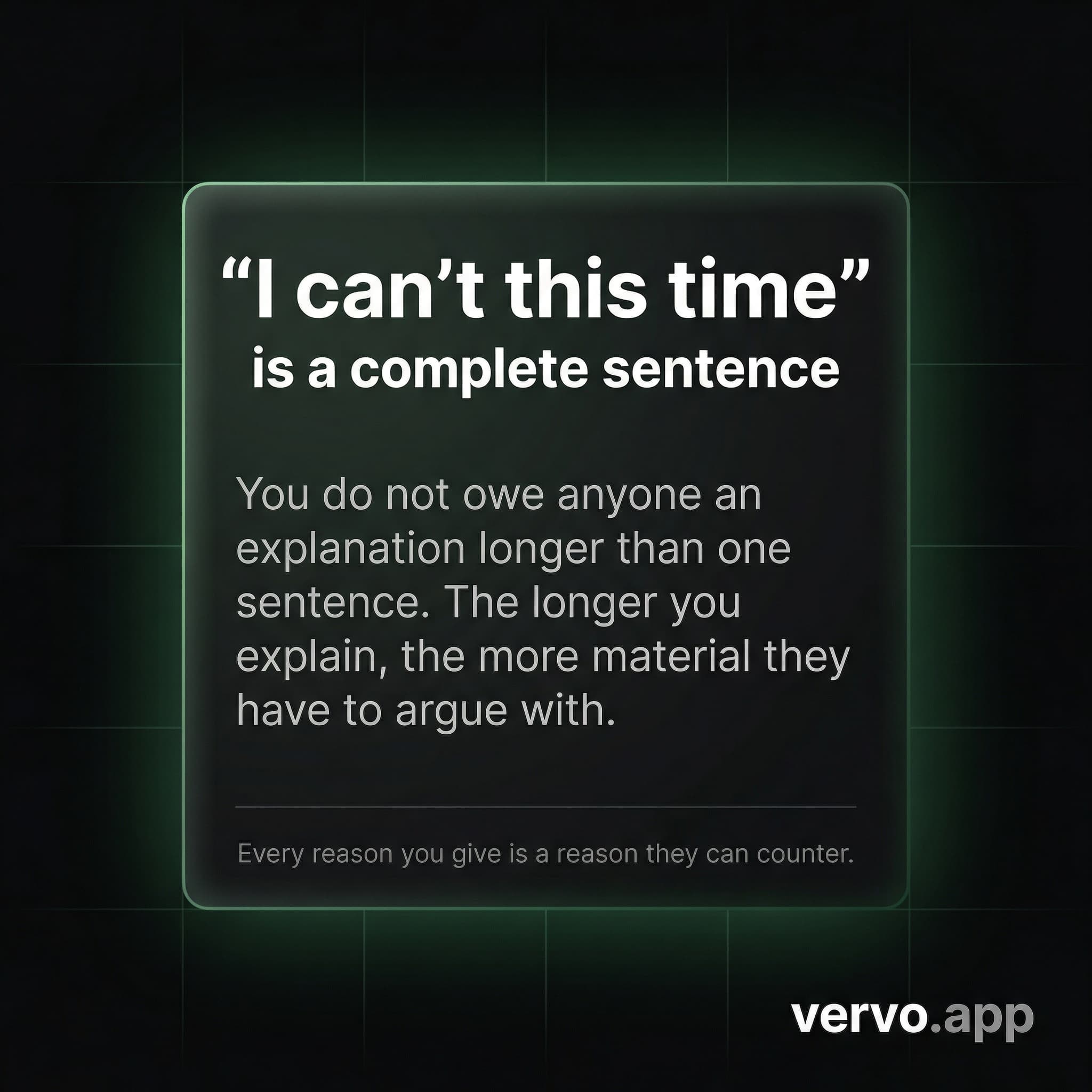
If you need to cancel plans entirely, the same principle applies. Brief. Honest. Done.
The Delayed Response as a Boundary Tool
Here's something nobody tells you: you don't have to respond immediately. And choosing when to respond is itself a form of boundary-setting.
When someone texts you something that demands an answer you're not ready to give -- the ask that's too big, the question that's too loaded, the message that's clearly testing how much they can get from you -- you are allowed to sit on it.
Not forever. Not ghosting. But taking an hour. Taking a day. Letting the urgency they created dissipate before you decide what you actually want to say.
The pressure you feel to respond immediately? That's their timeline, not yours. You get to set your own.
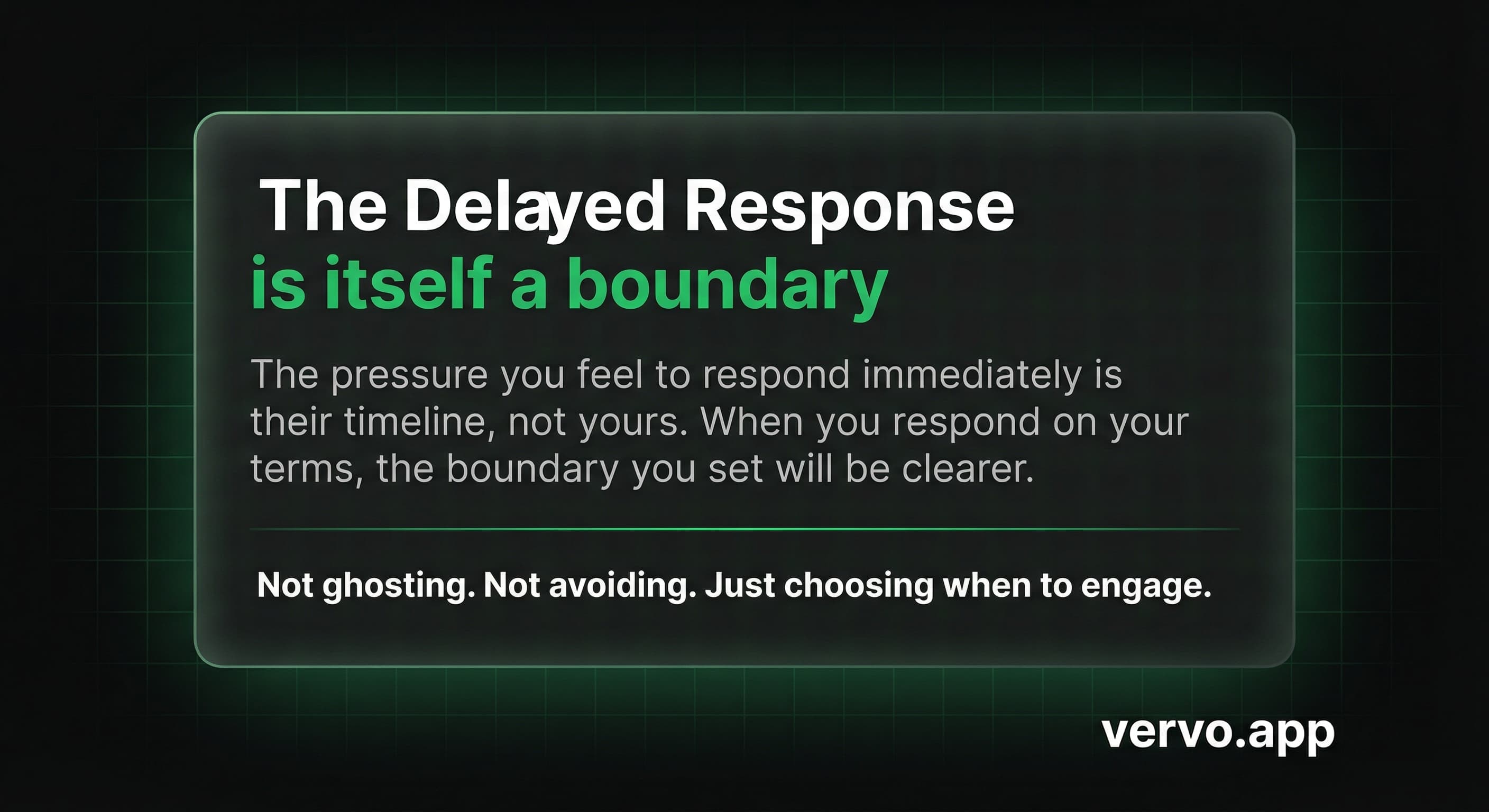
This doesn't mean avoiding hard conversations. It means not letting someone else's urgency hijack your judgment. When you respond on your terms, after you've had time to think, the boundary you set will be clearer and you'll be more likely to hold it.
Start Small
If setting boundaries feels impossible, you're probably trying to start with the hardest ones. Don't.
Practice on low-stakes stuff first. The group chat message you don't need to respond to. The friend's text about plans you're genuinely unsure about -- "Let me check my schedule and get back to you" instead of an immediate yes. The coworker who asks for a favor you can actually decline without drama.
Build the muscle. Get used to the discomfort of not immediately accommodating. Notice that the world doesn't end when you take your time or say no to something small.
Then, when the hard boundary comes -- the one that matters, the one you've been dreading -- you'll have practice. The words will come easier. The guilt will be more manageable. And you'll remember all the other times you held the line and everything was fine.
The Uncomfortable Truth
A boundary is not a punishment. It's not a rejection. It's information. You're telling someone what works for you and what doesn't. That's it.
The people who matter will respect it. They might be surprised at first -- especially if you've spent years saying yes to everything -- but they'll adjust. They'll appreciate knowing where you stand instead of guessing whether you're actually fine or secretly resentful.
The people who don't respect it are telling you something important about how they see the relationship. Someone who can't handle your no was never really asking. They were expecting.
If you're stuck on the wording -- if you've been drafting and deleting for twenty minutes trying to find the magic phrase that sets the boundary without sounding mean -- screenshot the conversation and see what Vervo suggests. Not because you can't say no. Because sometimes seeing the options laid out makes it easier to pick one and send it.
Your time is yours. Your energy is yours. And the people who deserve access to both are the ones who respect when you say "not right now."
Say the thing. Set the boundary. It's going to be fine.