What to Text Someone Who Is Grieving (Without Making It About You)
You want to say the right thing but you're afraid of making it worse. Here's what actually helps when someone you care about is going through loss.

You've been staring at the text field for fifteen minutes now. Type something. Delete it. Type something else. Delete that too.
Someone you care about just lost someone they loved. You want to say the right thing. But the right thing feels impossible to find, and the wrong thing feels like it's everywhere -- one misplaced word away from making their worst day even worse.
So you sit there. Paralyzed. And eventually, you close the app and tell yourself you'll send something later.
I've done this. More than once. And I've been on the other side too -- waiting for a message that never came from people I thought would show up.
Here's what I learned: the silence hurts more than any awkward text ever could.
Why Do Most People Say Nothing?
It's not apathy. Most people who go silent during someone else's grief aren't cold or careless. They're scared.
Scared of saying something stupid. Scared of making the person cry. Scared of not knowing how to handle the response. Scared of reminding them of the thing they're trying not to think about -- as if they've forgotten for even a second that their mom died or their best friend is gone.
That fear makes sense. Death is uncomfortable. Our culture doesn't teach us how to talk about it. We don't have a script, so we freeze.
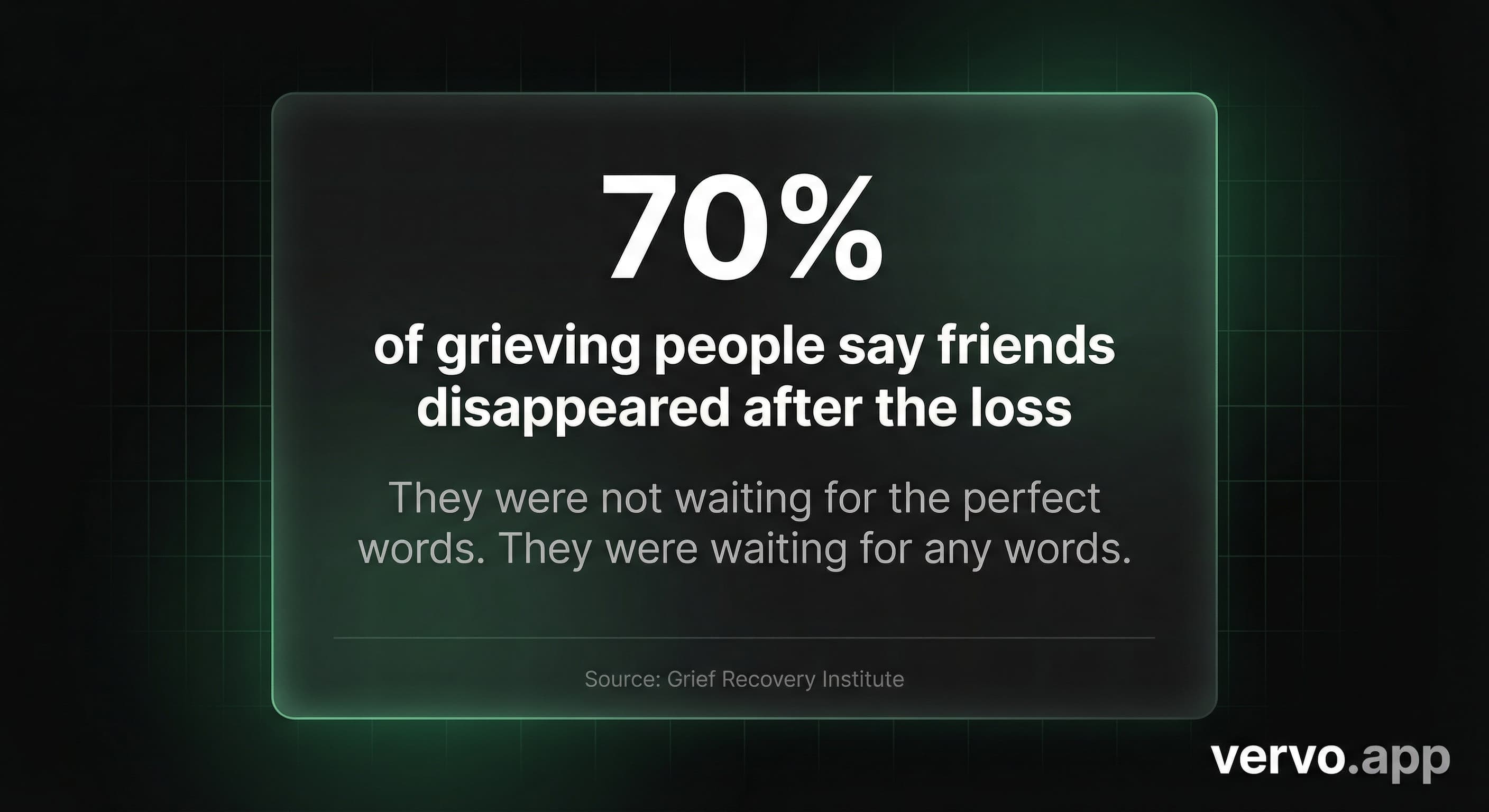
But here's the thing nobody tells you: the grieving person isn't waiting for you to say the perfect thing. They're waiting for you to say anything. They're scanning their phone wondering who will show up and who will disappear. And every hour of silence answers that question.
If you're prone to overthinking every text, this is one of those situations where the overthinking is lying to you. Any text you send will be better than the nothing you're considering.
What Should You Never Text Someone Who's Grieving?
Some phrases that feel comforting are actually the opposite. Not because you're a bad person for thinking them -- these are culturally ingrained responses -- but because they land wrong when you're the one in pain.
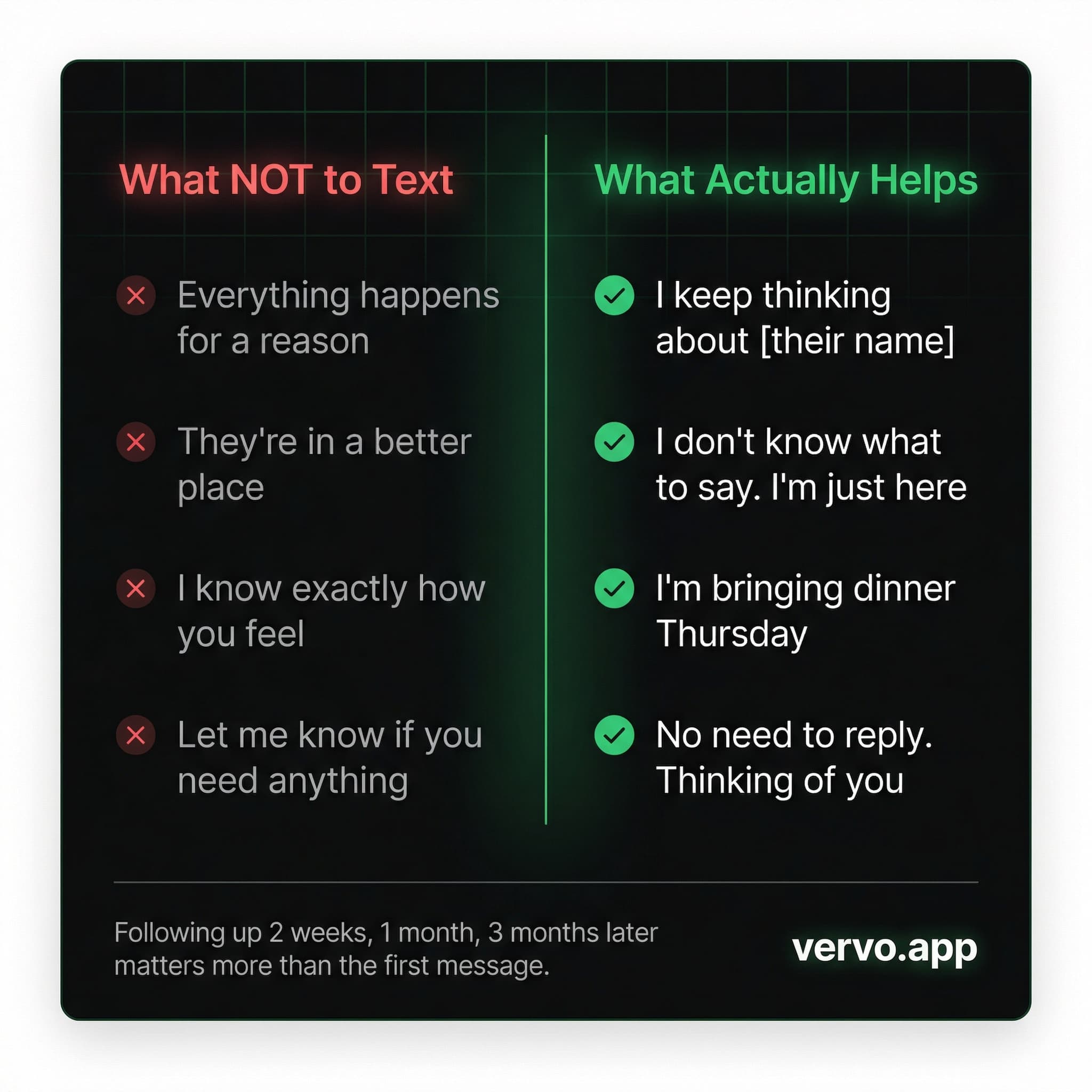
"Everything happens for a reason." This is the number one thing grieving people cite as unhelpful. When someone's dad just died, telling them it's part of a bigger plan feels like you're minimizing their loss. There is no reason good enough to explain why this happened. Don't try to invent one.
"They're in a better place." You might believe this. They might even believe it too. But in the raw early days of grief, "better place" sounds like "better than with me." It's not the comfort you think it is.
"At least they didn't suffer." The "at least" reframe is an attempt to silver-lining something that can't be silver-lined yet. Even if the death was peaceful, the absence is brutal. Minimizing one doesn't help the other.
"I know exactly how you feel." You don't. Even if you've lost someone too, grief is not a universal experience. Your loss was yours. Theirs is theirs. Making it about your experience shifts the focus away from them.
"Let me know if you need anything." This one feels helpful but it's actually a burden. It puts the work on the grieving person to figure out what they need, then find the energy to ask for it, then feel guilty about asking. If you want to help, make a specific offer instead.
Here's the difference:
Now with a specific offer:
The first one requires her to do the emotional labor. The second one does the labor for her.
What Actually Works When Texting Someone in Grief?
After reading dozens of accounts from people who've lost someone -- and after losing people myself -- there are patterns in what helps.
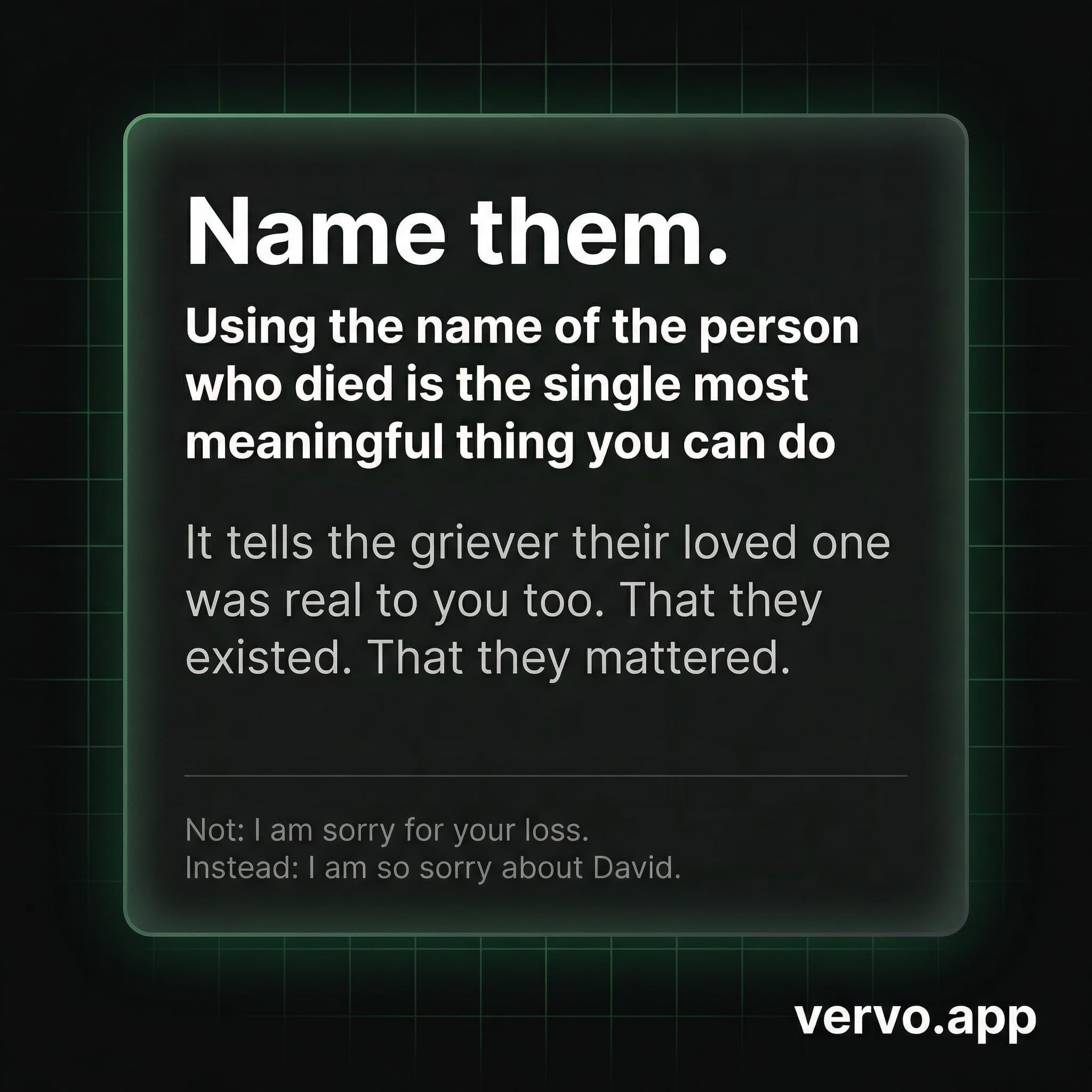
Name the person who died. This is the single most meaningful thing you can do. "I'm so sorry about your mom" hits different than "I'm so sorry for your loss." Using the person's name -- even better, using a specific memory -- tells the griever that their loved one was real to you too. That they existed. That they mattered.
"I keep thinking about how David used to do that ridiculous laugh at his own jokes. I'm going to miss him." That text means more than any generic sympathy card ever could.
Keep it short. This is not the moment for a long emotional paragraph about your feelings. The grieving person does not have the bandwidth to process your grief on top of their own. A few sentences is enough. Say what you mean. Stop.
Acknowledge that there's nothing to say. Sometimes the most honest text is: "I don't know what to say. I just want you to know I'm here." That's not a cop-out. It's true. And truth lands better than platitudes.
Don't ask "how are you?" They're terrible. That's how they are. And answering that question means performing okayness for your comfort. Instead try: "No need to reply. Just thinking about you today."
Here's what that looks like:
Short. Specific. Low-demand. That's the formula.
How Should You Text Different People in Your Life About Grief?
The right message depends on your relationship with the person.
For a close friend: You can be more direct and emotional. "This is so unfair. I love you and I'm here for whatever you need. I'm going to keep texting you even if you don't reply." Close friends can handle -- and often appreciate -- directness about your feelings for them.
For a coworker: Keep it professional but human. "I was so sorry to hear about your father. Please don't worry about anything here -- we've got you covered. Take all the time you need." Acknowledge the loss, remove work-related pressure, don't overstep.
For a family member: You probably know the tone that works. But one thing that matters with family: don't wait for someone else to send the text first. In family systems, everyone is often waiting for everyone else. Be the one who breaks the silence.
For an acquaintance: A simple "I heard about your loss. I'm so sorry." is enough. You don't need to have the perfect words when the relationship is distant. The point is just to show up.
If someone in your life is going through a harder stretch -- not just a loss but a longer period of struggle -- the approach shifts. I wrote more about that in how to text someone who is struggling.
When Should You Follow Up?
This is where most people drop the ball.
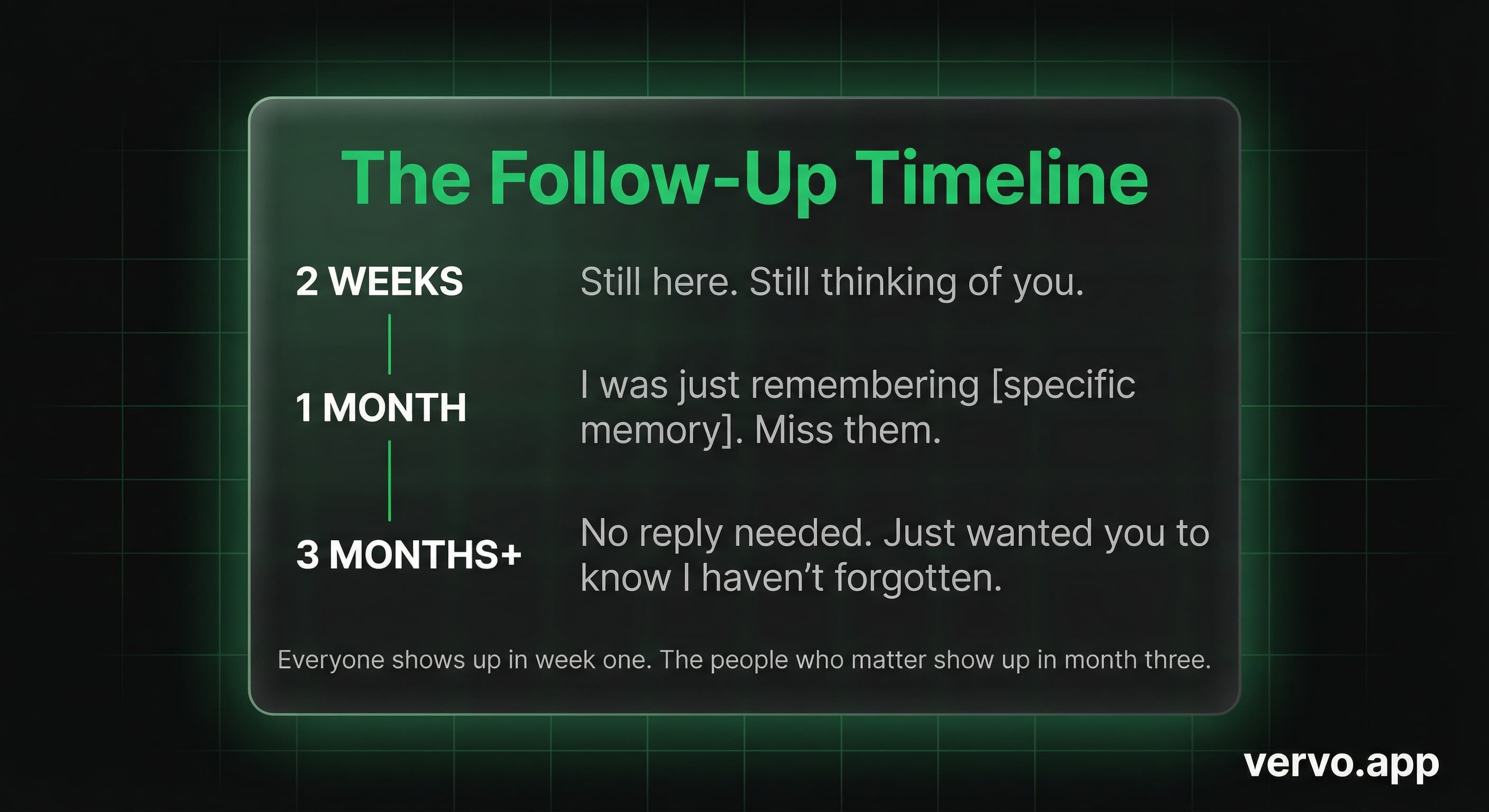
The first few days after a death, the grieving person is flooded with messages, calls, casseroles, and attention. Everyone shows up in week one. Then life returns to normal for everyone else -- but not for the person who lost someone.
Week three is lonely. Month two is lonelier. The anniversary, the birthday, the holidays -- those days hit hard and often hit in silence.
The most meaningful texts I ever received after losing someone came weeks and months later. Not "checking in to see if you're okay" -- that feels like a performance review. Just: "Thinking about you today. No reply needed." Or: "I was just remembering that time [specific memory]. Miss him."
If you want to actually support someone through grief, put reminders in your calendar. Two weeks out. One month out. Three months out. The anniversary. Send something short each time. You don't need new words. Just "Still here. Still thinking of you."
That's the difference between showing up once and actually being there.
What Should You Do When They Don't Respond?
They might not. And that's okay.
Grief is exhausting. The act of reading a kind message, feeling the feelings it brings up, and then crafting a response -- that can feel like too much. Some people go silent for weeks. Some people respond to some messages and not others. Some people don't have the energy to type "thank you" even when they're grateful.
This is not about you. Don't follow up with "did you get my message?" Don't take the silence personally. Don't stop texting just because they stopped replying.
The texts matter even if they're never acknowledged. The texts that got me through my own grief weren't the ones I replied to -- they were the ones I read at 2am when I couldn't sleep, knowing someone out there was thinking of me.
If you struggle with reading into short replies, remember that grief changes all the normal rules of texting. A "thanks" from someone who just lost their parent is not a brush-off. It's probably all they could manage.
The Text You've Been Avoiding
You already know who it is. You've been thinking about them since you started reading this. Maybe it's been days. Maybe it's been weeks. Maybe it's been months and you feel like the window has closed.
The window hasn't closed. It's never too late to say "I've been thinking about you. I'm sorry I didn't reach out sooner. I didn't know what to say."
That's an honest text. And honest texts land.
Don't wait for the perfect words. The imperfect ones you send today matter more than the perfect ones that never leave your drafts.
If you're stuck -- if you've typed and deleted so many times that you're ready to give up -- screenshot the conversation and run it through Vervo. Sometimes seeing options laid out breaks the paralysis. The important thing is that you send something.
They need to see your name in their notifications. That's what matters. Not the words you choose. The fact that you chose to show up at all.