How to Cancel Plans Over Text Without Being That Person
How to cancel plans over text without killing the friendship. Copy-paste scripts for every scenario, backed by MSU research.
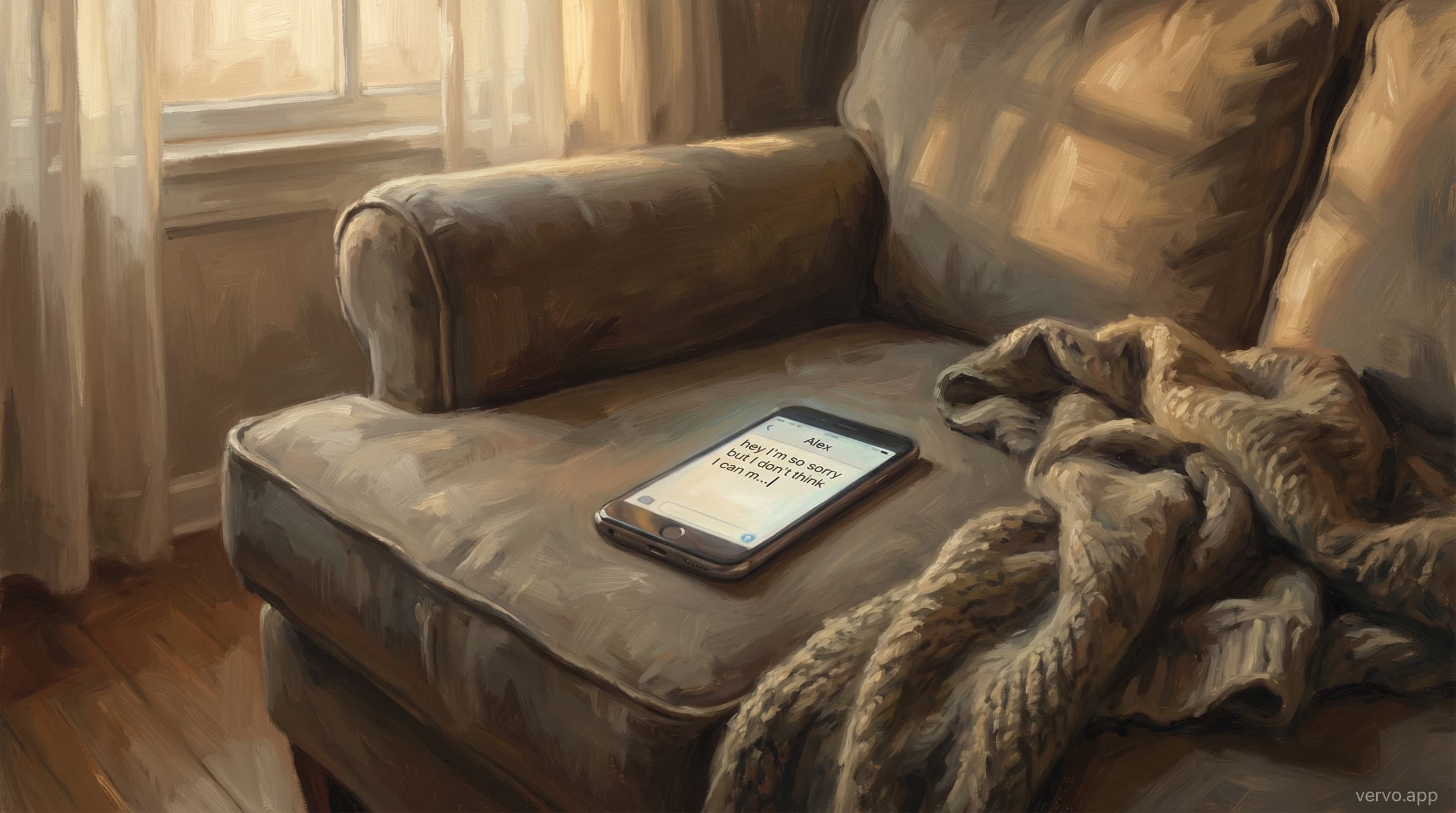
Two weeks ago you said yes. Two-weeks-ago you were a different person. That version of you had energy, optimism, and a clear calendar. Today you have none of those things. You have a half-typed cancel text, a growing sense of dread, and a brain telling you that sending this message will end the friendship, mark you as flaky forever, and somehow get back to everyone you know.
None of that is true. The research is clear about it. Your brain is not.
Here is what to actually text, when to send it, and what to never say under any circumstances.
Does Canceling Plans Actually Ruin Friendships?
No. And the numbers make that plain.
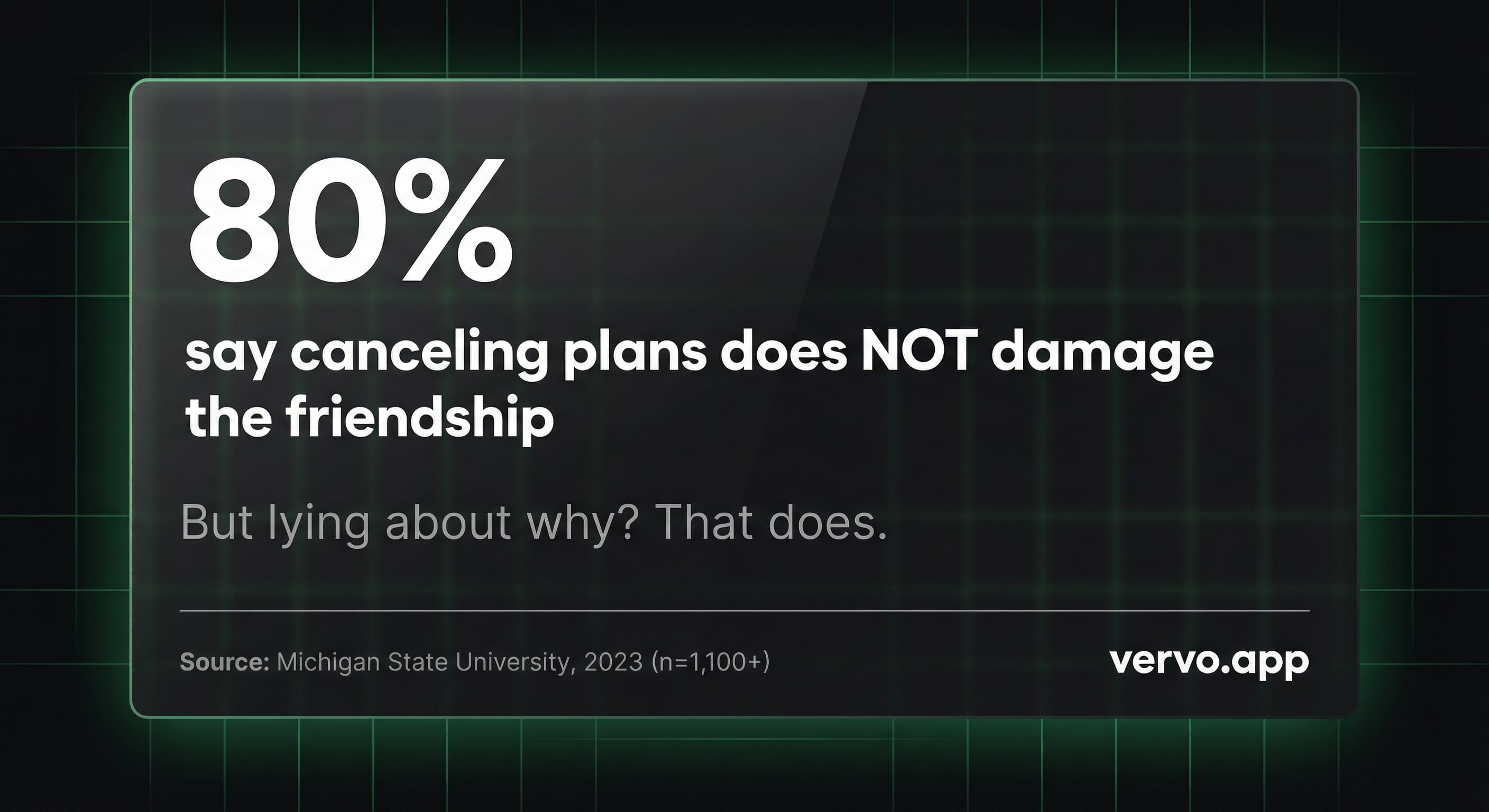
A 2023 study out of Michigan State University led by Dr. William Chopik surveyed more than 1,100 people about how they actually feel when a friend cancels. The result: 80% said a cancellation does not affect the friendship.
What does damage it is lying. When recipients later discover the stated reason was false, the relationship takes a real hit. The cancellation itself? Most people absorb it without drama. The cover story is what they remember.
Your brain is running a catastrophe simulation that the data does not support. The goal of this article is to give you something concrete to send so you stop rewriting and just send it.
What Do People Actually Want When You Cancel?
Three things. That is it.
Honesty. A brief, real reason -- not a performance of guilt, not a fabricated emergency.
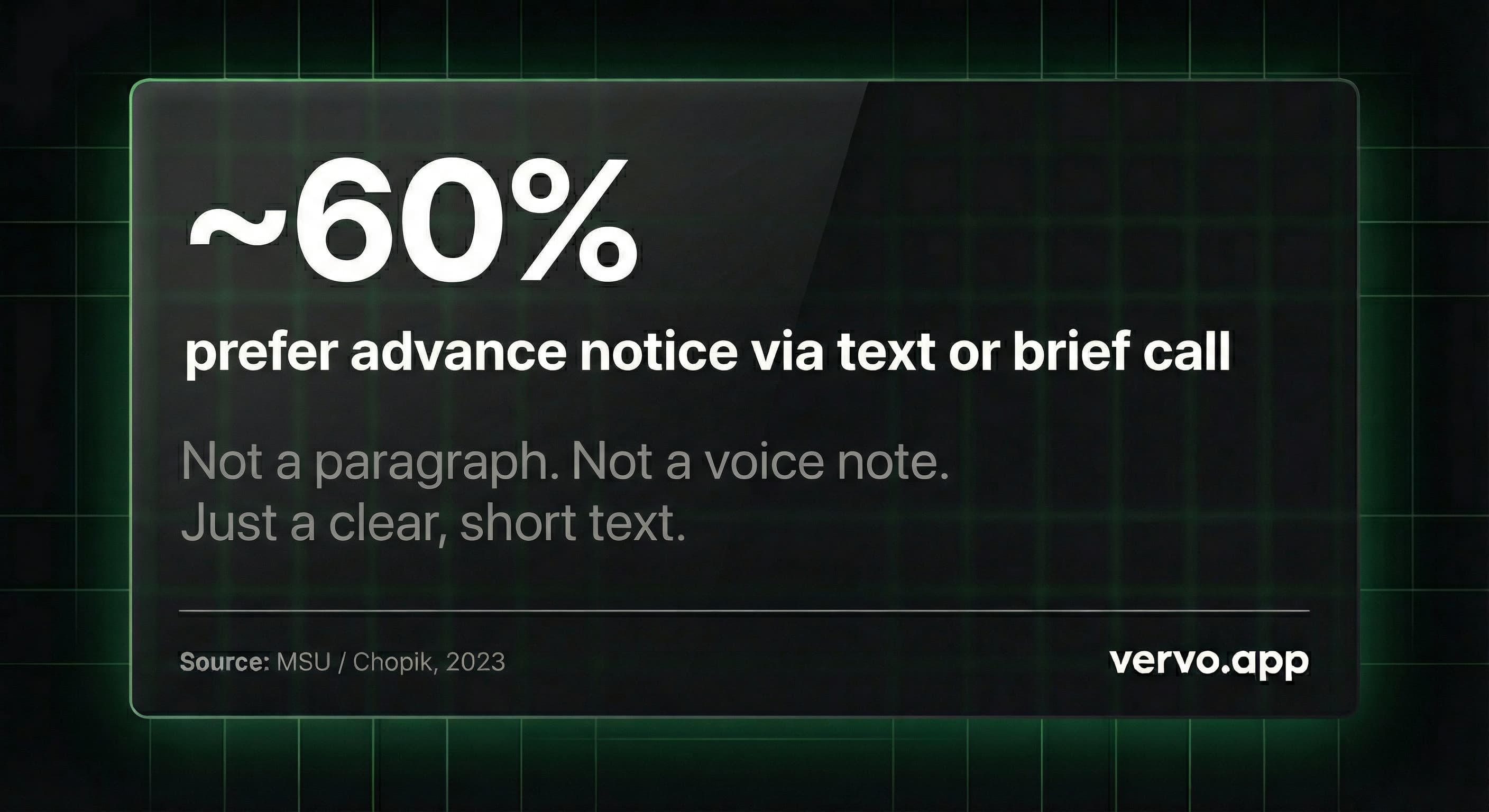
Advance notice. Nearly 60% of people want to hear via a short text or quick call as soon as you know. They do not want a long explanation. They want enough time to adjust their plans.
Brevity. This connects to the second point. Long cancellation texts read as guilt-management, not communication. You are trying to make yourself feel better. The other person mostly just needs the information.
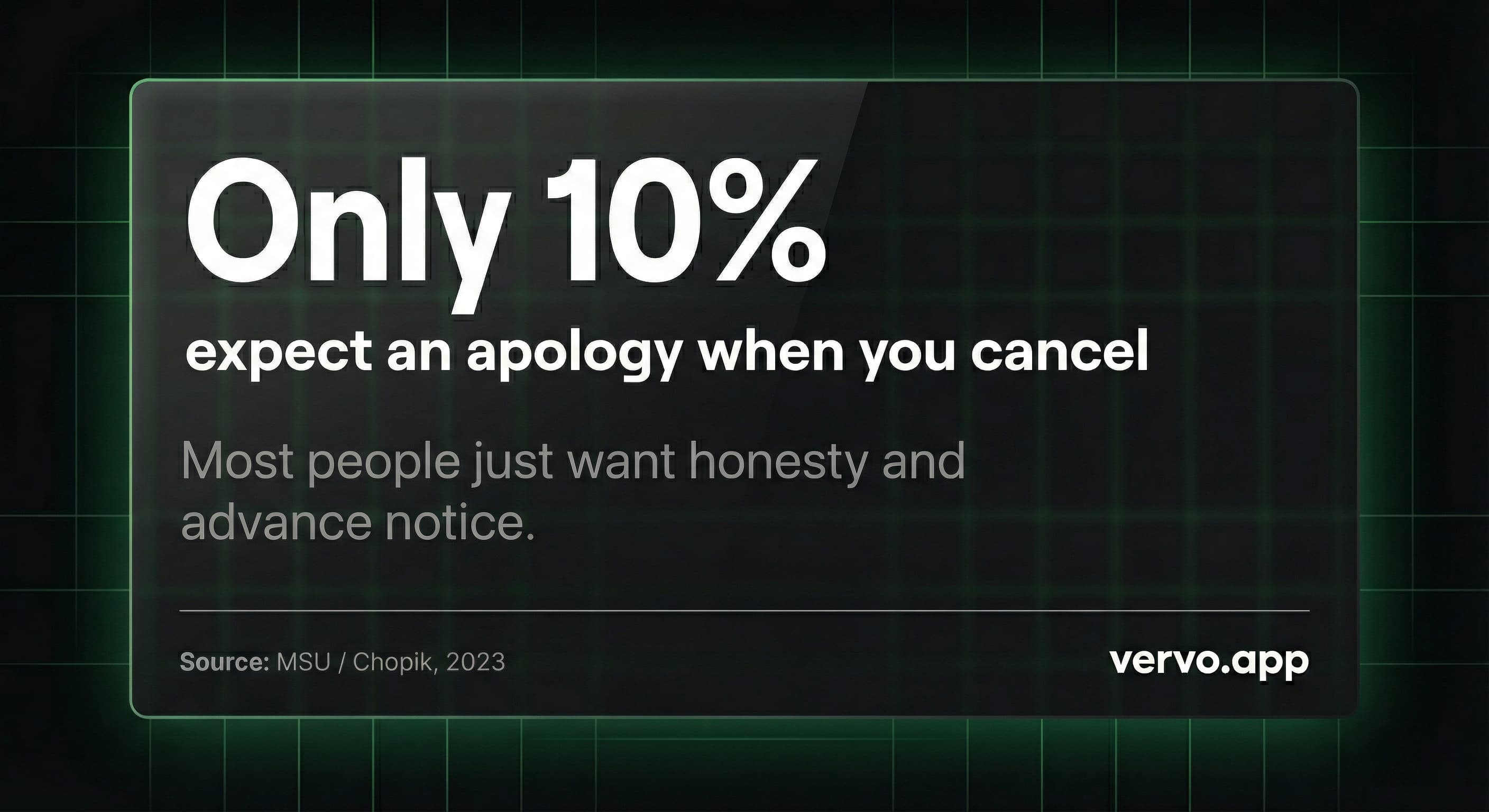
One more thing the research clarifies: only 10% of people actually expect an apology. Most people over-apologize because they assume the other person expects it. The data says otherwise. A brief acknowledgment -- "I hate doing this" -- lands better than three paragraphs of sorry.
What Are Acceptable Reasons to Cancel?
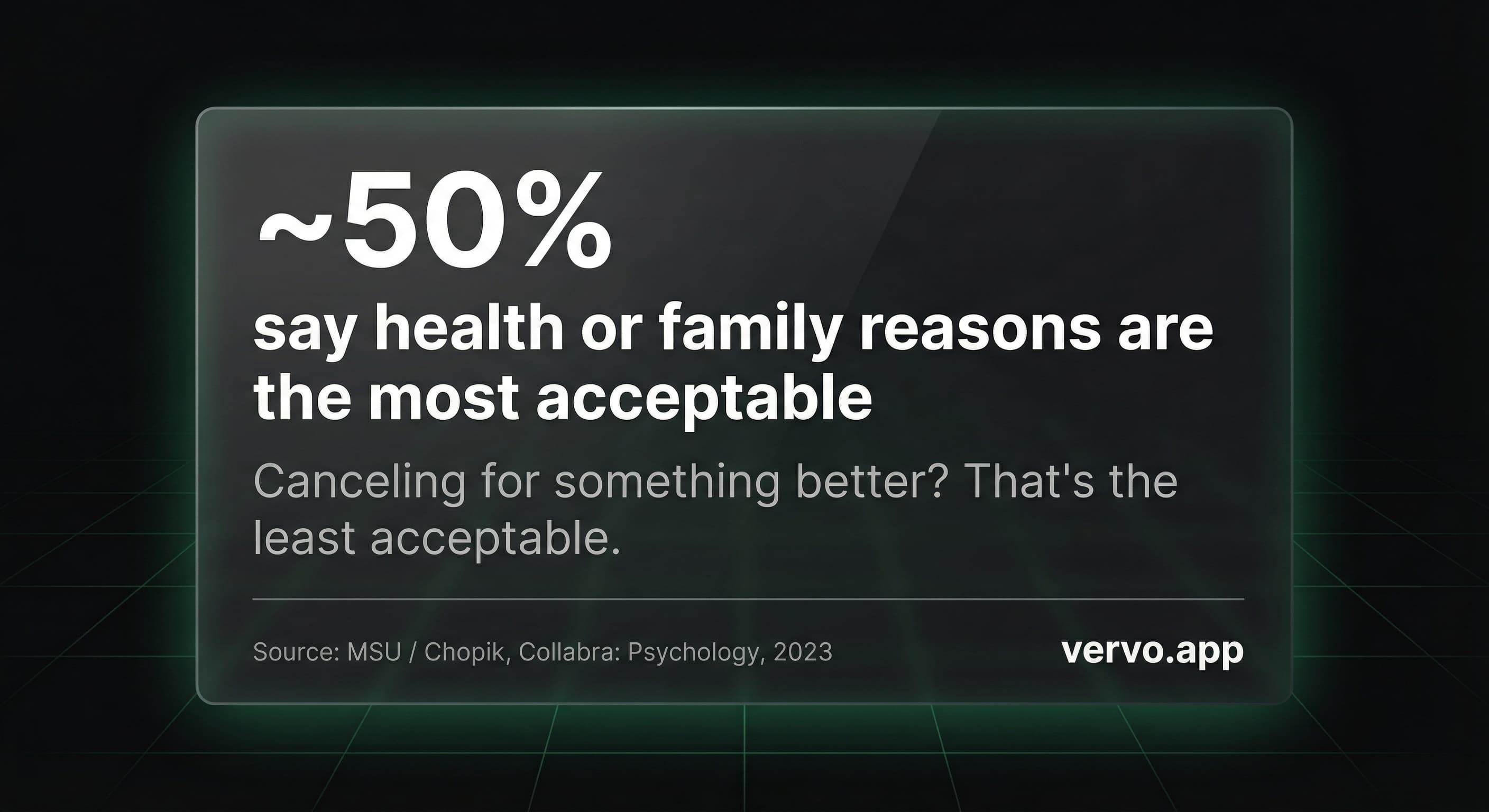
About 50% of people rate health or family situations as the most understandable reasons to cancel. Overwhelm and needing to recharge are gaining acceptance, especially among younger people -- framing matters here. "I'm not in a good headspace" lands better than "I just don't feel like it."
The least acceptable reason, according to the same research: canceling because something better came up. A separate 2021 study found that repeatedly canceling for social upgrades is associated with narcissistic and manipulative traits. Worth knowing.
One thing you do not owe anyone: a full explanation over text. A brief, honest reason is enough. You are not filing a report.
How Early Should You Send the Cancellation Text?
As early as possible. That is the rule.
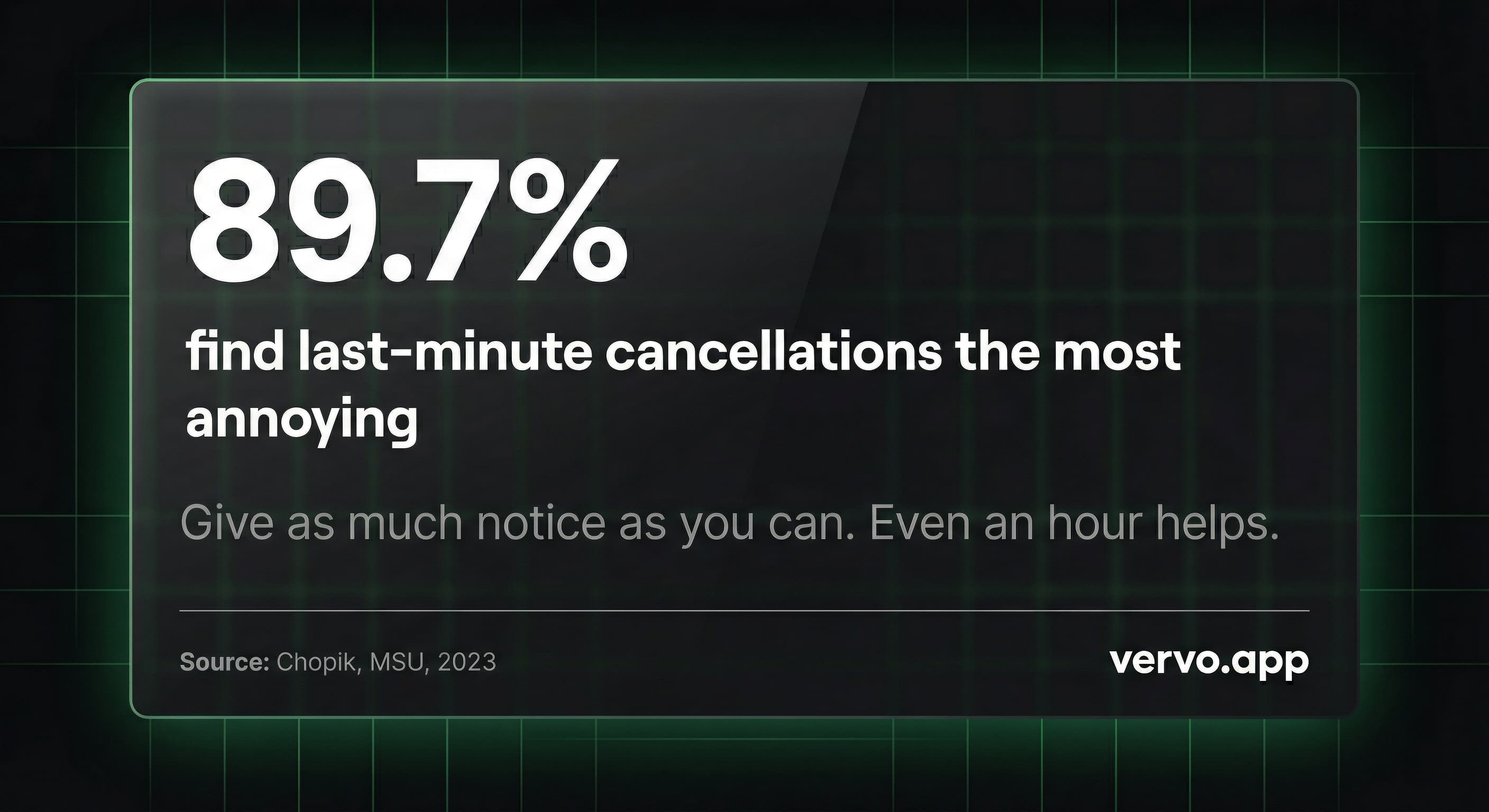
The MSU research found that 89.7% of people rate being told a few minutes before the event as the most annoying possible outcome. Not the cancellation itself. The timing.
The moment you know you cannot make it -- send the text. Even if it is three days out. Especially if it is three days out. The other person may have already arranged childcare, turned down other plans, or bought something for the occasion. Give them time to adjust.
The exception is a genuine emergency. If something serious happens on the day of, you send the text the moment you can. People understand this. "Family emergency, can't make it tonight. I'll explain when I can" is complete.
What Should You Actually Text?
The structure that works across every scenario: acknowledge + reason + reschedule offer.
You are not composing an essay. You are giving three pieces of information. Here is how that looks in practice across the situations that actually come up.
Friend, same-day sick: "Hey -- I woke up feeling pretty rough and I don't want to get you sick. Can we reschedule for next week? I'll reach out when I'm feeling better."
Friend, overwhelmed / need to recharge: "I need to be honest -- I'm completely depleted today and I'd be bad company. Can we push this? I really do want to see you."
Advance notice, work conflict: "Something came up at work that I can't move. I'm really sorry to do this -- can we find another time? I'll send some options."
Same-day work conflict: "A work thing just landed that I have to deal with tonight. I hate canceling this late. Can I make it up to you this week?"
Family situation: "Something came up with my family that I need to handle. I'll explain more when I can. Can we reschedule?"
Financial reason, advance notice: "I have to be honest -- it's a tight month and I should have said that sooner. Can we do something lower-key instead, or push it out a bit?"
Canceling a date: "Hey, I need to cancel tonight. Something came up that I have to deal with. I'm still interested in meeting -- are you free [specific day]?"
Group plans: "Hey everyone -- I can't make it tonight. Go ahead without me and I'll catch you next time."
Last-minute, genuine emergency: "Family emergency. Can't make it tonight. I'll explain when I can."
Chronic canceler, acknowledging the pattern: "I know I've canceled a lot lately and I don't want that to be the dynamic between us. I'm going through something but I do want to see you. Can we lock in a specific day?"
Each of these is intentionally short. If you feel the urge to write more, that is your guilt talking. Send the short version.
If you find yourself struggling to figure out what tone fits your specific situation, a screenshot to reply app can generate three options -- casual, warm, or direct -- so you are not starting from nothing.
What Is the Worst Way to Cancel?
Three options, all bad.
Ghost. No message at all. Not a cancellation. A relationship injury.
Lie. A fabricated emergency that the other person might later see through. The MSU data is specific on this: the lie does more damage than the cancellation ever would have.
Over-explain. A 400-word message about how much you were looking forward to it, how guilty you feel, how this never happens, how you hope they understand. This is not communication. It is anxiety management at the other person's expense. They now have to absorb your guilt in addition to adjusting their evening.
Short, honest, early. That is the whole formula.
What If You Have Anxiety About Canceling?
Some people freeze at this moment not because they are flaky but because the act of canceling triggers a genuine anxiety response. The blank text field sits there. They type and delete. Time passes. Now it is even later and the guilt is worse.
If how to respond to dry texts is something you spend too much time on -- agonizing over tone, second-guessing every word -- the same thing probably happens when you need to send a difficult message. You are not bad at texting. You are stuck in the spiral.
The fix is not to get better at writing cancel texts on your own. The fix is to not start from a blank screen. Vervo gives you three versions of whatever you need to say -- you screenshot the context, pick the tone that fits, and send. The hard part is choosing. The blank-screen problem disappears.
Sources
- Caron, Thomas, Torres, Oh, Chopik. "How to Cancel Plans With Friends: A Mixed Methods Study of Strategy and Experience." Collabra: Psychology, 2023. UC Press
- MSU Today press release. "Cancelling plans research." January 2023. MSU Today
- Science of People summary of Chopik research. scienceofpeople.com