The Community College to University Transfer Guide (Save $30K and Still Get the Same Degree)
Step-by-step guide to saving tens of thousands on your bachelor's degree by starting at community college. Free tuition programs, FAFSA tips, transfer timelines, and how to not lose credits.

Nobody puts this on a poster at your high school career fair: you can get the exact same bachelor's degree for $30,000 less by starting at a community college.
Same diploma. Same job prospects. Same "I graduated from State University" on your resume. The only difference is that you didn't pay university prices for your English 101 class where the professor showed a movie every other Friday.
This is the step-by-step guide. Not the "consider your options" pamphlet your guidance counselor hands out. The actual playbook -- what to do, when to do it, and how to not accidentally waste a semester's worth of credits along the way.
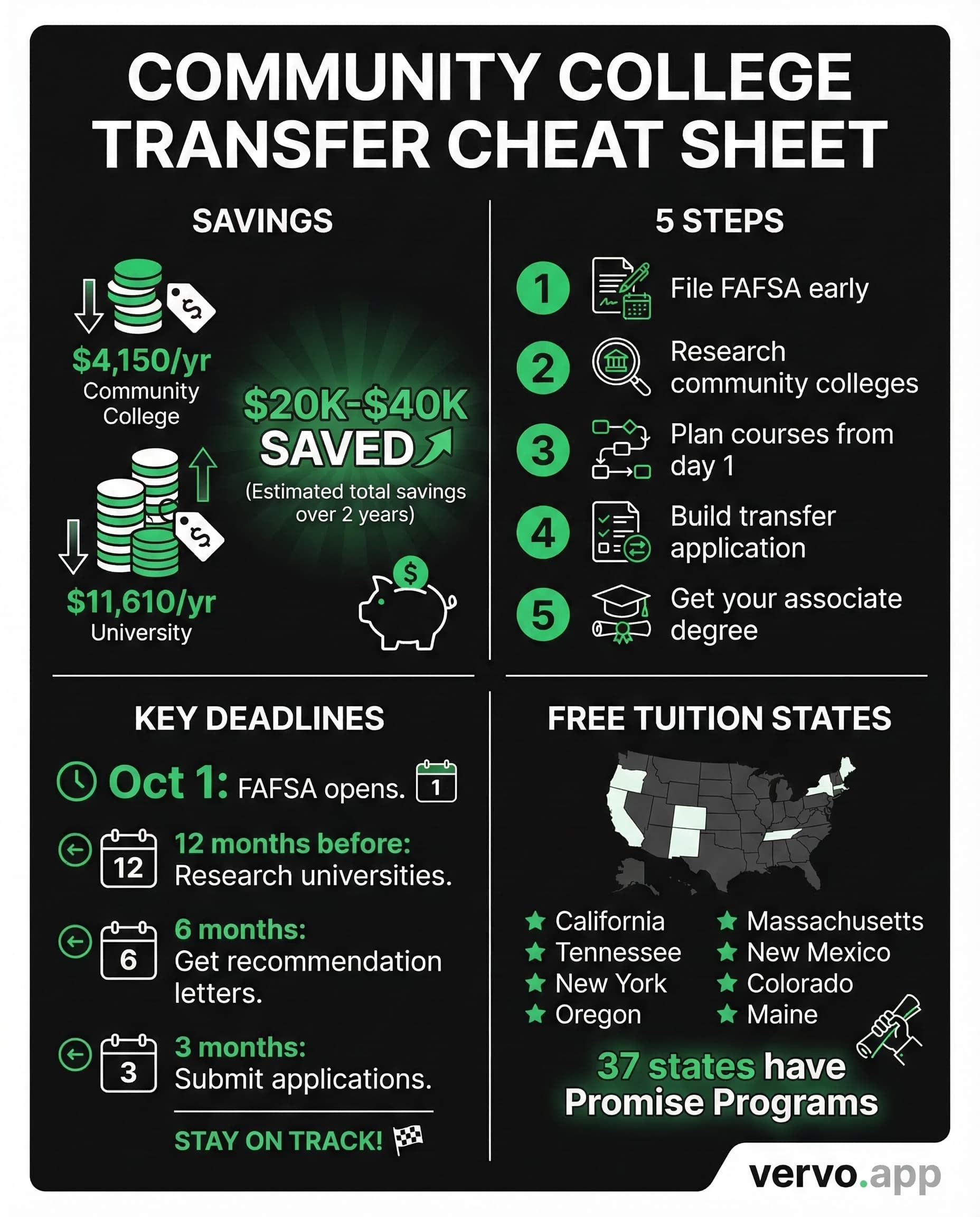
How much money are we actually talking about?
Let's do the math that nobody does for you in high school.
| Community College (2 years) | University (2 years) | |
|---|---|---|
| Average annual tuition | $4,150 | $11,610 |
| 2-year tuition total | $8,300 | $23,220 |
| Books & supplies (2 years) | $2,844 | $2,400 |
| Total | $11,144 | $25,620 |
That's a difference of roughly $14,500 in tuition alone. If you factor in room and board (which you skip by living at home during community college), the gap jumps to $20,000 to $40,000.
And here's the part that matters most: the degree you get at the end says the exact same thing. Your diploma from State University doesn't have an asterisk that says "but they started at community college." Nobody asks. Nobody cares. They care that you finished.
Wait -- can community college actually be free?
Yes. In 37 states, there are programs that make community college tuition free or nearly free. They're called Promise Programs, and most people don't know they exist.
Here are some of the biggest ones:
| State | Program | What It Covers |
|---|---|---|
| California | College Promise Grant | Enrollment fees waived for eligible residents |
| Tennessee | Tennessee Promise | Full tuition at any community or technical college |
| New York | Excelsior Scholarship | Free tuition for families earning under $125K |
| Oregon | Oregon Promise | Up to $4,000/year at community college |
| Massachusetts | MassEducate | Free tuition and fees for all students, any age |
| New Mexico | Opportunity Scholarship | Covers two-year and four-year public colleges |
| Colorado | Colorado Promise | Up to 65 credit hours free for families under $90K |
| Maine | Free College Scholarship | Full tuition for recent HS grads, no income limit |
| Rhode Island | RI Promise | 2 years free at CCRI for recent HS grads |
| Nevada | Nevada Promise | Free for residents under 20 |
How to check your state: Go to freecollegenow.org/promise_programs and search by state. You can also call your local community college financial aid office -- they will tell you exactly what you qualify for in five minutes.
Most of these are "last-dollar" programs, meaning they cover whatever tuition is left after your other financial aid (Pell Grant, state grants) is applied. For many students, this means community college costs literally $0.
Step 1: File the FAFSA (do this first, do this now)
The FAFSA (Free Application for Federal Student Aid) is how you unlock free money for college. Not loans. Grants. Money you don't pay back.
Key facts for 2025-2026:
- FAFSA opens: October 1 (for the following school year)
- Federal deadline: June 30, 2026
- But your real deadline is: as early as possible
Students who file the FAFSA in the first three months get twice as many grants on average as students who file later. That's because much of the aid is first-come, first-served. Wait until May, and the money might be gone.
What you need to file
- Your Social Security number
- Your (or your parents') federal tax return from the prior year
- Bank statements and records of investments
- Records of untaxed income
The maximum Pell Grant for 2025-2026 is $7,395. At a community college that charges $4,150 in tuition, the Pell Grant alone can cover your entire tuition and leave money for books.
File at studentaid.gov. It's free. Never pay anyone to help you fill it out.
Step 2: Research community colleges near you
Not all community colleges are the same. Here's exactly what to look for:
Check the transfer rate
This is the most important number. A community college with a high transfer rate means more students successfully move on to four-year universities. You want a school that has a track record of getting people where they want to go.
Where to find it: Go to nces.ed.gov/collegenavigator, search for the community college, and check their outcomes data.
Check for articulation agreements
An articulation agreement is a formal deal between a community college and a university that says: "If your student takes these specific courses, we will accept all of them for credit."
This is the single most important thing that determines whether your credits transfer or get thrown in the trash.
Where to find them: Go to your community college's website and search "transfer agreements" or "articulation agreements." They usually have a page listing every university they have deals with, organized by major.
Check for guaranteed transfer programs
Some states have programs that guarantee you admission to a state university if you complete your associate degree with a minimum GPA:
- California: TAG (Transfer Admission Guarantee) to 6 UC campuses; ADT guarantees admission to CSU with junior standing
- Florida: 2+2 program guarantees AA graduates admission as juniors to all State University System schools
- Virginia: Guaranteed admission to 30+ colleges including UVA and Virginia Tech
- Washington: Direct Transfer Agreement to all state four-year institutions
- Massachusetts: MassTransfer to 10 state universities including UMass
Check if they offer your intended major's prerequisites
Call or email the university you eventually want to attend. Ask: "What courses do I need to complete at a community college to transfer into [your major]?" Get this in writing. Print it out. Tape it to your wall.
Step 3: Plan your courses from day one
This is where most people mess up and where the biggest money gets wasted.
The average transfer student loses 13 credits during transfer. That's nearly an entire semester of classes that don't count toward their degree. At university tuition rates, that's $5,800 in wasted money and an extra semester of your life.
Here's how to lose zero credits:
Meet with an advisor immediately
Not next month. Not next semester. During orientation or your first week. Tell them: "I plan to transfer to [university name] to study [major]. Help me build a course plan that transfers every single credit."
Only take courses on the approved transfer list
Your community college will have a list of courses that are guaranteed to transfer to specific universities. Take those courses. If a course isn't on the list, don't take it unless your advisor confirms it will count.
Use transfer equivalency tools
Most universities have online tools where you can plug in your community college courses and see exactly how they'll transfer:
- California: ASSIST.org -- shows exactly which CC courses transfer to which UC/CSU classes
- National tool: Transferology.com -- covers thousands of institutions nationwide
Complete your general education requirements first
The courses that transfer most reliably are general education: English composition, college algebra or calculus, lab sciences, history, psychology, speech. These are universal. Take them at community college where they cost a fraction of the price.
Get your associate degree before transferring
Many guaranteed admission programs require you to complete an Associate of Arts (AA) or Associate of Science (AS) degree. Even if it's not required, having the associate degree:
- Often guarantees all your gen ed credits transfer as a block
- Gives you junior standing at the university
- Looks better on your transfer application
- Is a degree you keep forever, even if life interrupts your bachelor's
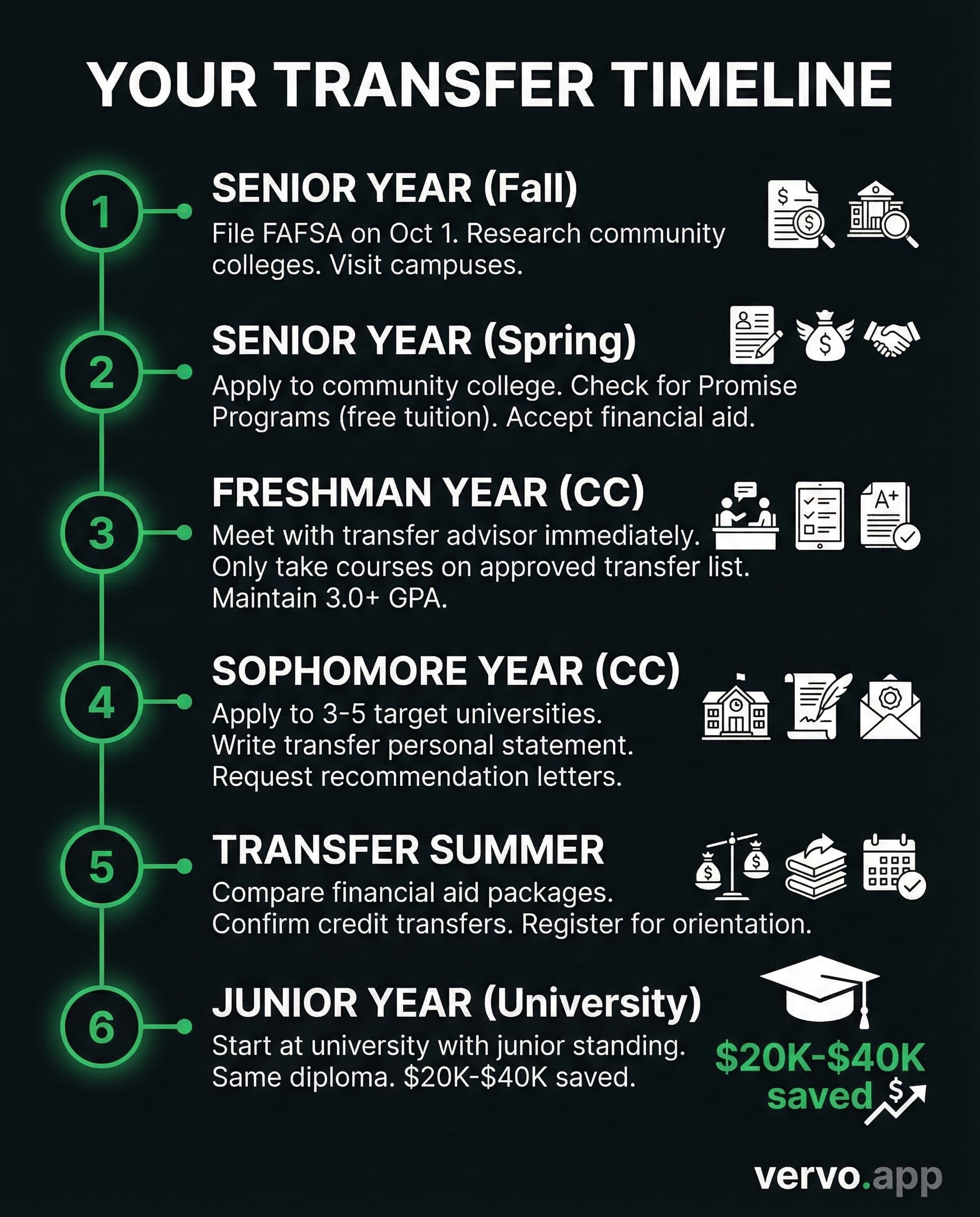
Step 4: Build your transfer application
Most universities have a separate transfer application process. Here's the timeline:
12 months before you want to transfer
- Research 3-5 target universities and their transfer requirements
- Note all application deadlines (priority deadlines are often December-February for fall transfer)
- Check for transfer-specific scholarships
6 months before
- Request letters of recommendation from community college professors
- Write your transfer personal statement (this is your chance to explain your journey)
- Gather your unofficial transcripts to review for accuracy
3 months before
- Submit applications before priority deadlines
- Request official transcripts be sent from your community college
- File the FAFSA for the upcoming year at your new university
- Apply for transfer scholarships (many universities have scholarships specifically for community college transfers)
After acceptance
- Compare financial aid packages from each school
- Confirm exactly which credits will transfer and which won't
- Register for an orientation for transfer students
- Connect with the transfer student community -- every university has one
Step 5: Avoid the 5 biggest transfer mistakes
I've seen these wreck people's plans over and over. Don't be that person.
Mistake 1: Taking random classes without a plan
Every class you take should be moving you toward transfer. That interesting pottery elective might be fun, but if it doesn't count toward your degree at the university, you just spent $500 and 15 weeks on nothing.
Mistake 2: Assuming all credits transfer
They don't. Some courses transfer as elective credit only (meaning they count toward your total credits but not toward your major requirements). That's essentially useless if it pushes back your graduation.
Mistake 3: Waiting too long to talk to the university
Contact the admissions office at your target university in your first semester of community college. Not your second year. First semester. They will tell you exactly what they want to see.
Mistake 4: Ignoring the GPA requirement
Most guaranteed admission programs require a minimum GPA of 2.5 to 3.0. Competitive programs in nursing, engineering, or business may require 3.5+. Know the number from day one and stay above it.
Mistake 5: Not applying for financial aid at the new school
You need to file a new FAFSA for your university. Transfer scholarships exist but nobody will hand them to you. Search the university's financial aid page for "transfer scholarships" and apply to every one you qualify for.
The real talk about community college
Let's address the thing nobody wants to say out loud.
There's a stigma. Your friends are posting move-in day photos at Big State University. You're driving to a campus that shares a parking lot with a strip mall. Someone at Thanksgiving asks where you go to school and you feel weird about it.
Here's what those people don't know: nearly half of everyone who earns a bachelor's degree in the United States attended a community college at some point. Half. That stat comes from the National Student Clearinghouse, and it's been consistent for years.
You know who else started at community college? The person graduating next to the student who spent four years at that university. They both walk across the same stage. They both get the same piece of paper. One of them has $30,000 less debt.
The stigma exists because people confuse the building with the education. But a calculus class is a calculus class. The derivative of x-squared is 2x whether you learn it in a lecture hall with 300 people or a classroom with 25.
How this connects to the rest of your life
Here's the thing about figuring out community college, financial aid, transfer applications, and all of this: it's overwhelming. And the overwhelm doesn't stay in its lane.
When you're stressed about whether your credits will transfer, you're also stressed about texting your professor to ask for a letter of recommendation. When you're nervous about your first day at the university, you're also nervous about texting your new roommate for the first time. When your parents ask how school is going and you don't know what to say, you stare at your phone the same way you stare at it when anyone asks something you're not ready to answer.
The anxiety is the same. It's all communication anxiety. And just like we built this guide to take the guesswork out of transferring, tools like vervo.app exist to take the guesswork out of those hard conversations. Screenshot the text, get three reply options, pick the one that sounds like you. Whether it's your academic advisor, your new roommate, or your mom asking why you missed Sunday dinner.
Five free replies a day. No keyboard access. No data stored.
Try vervo.app free -- 5 replies a day, no credit card.
Sources
- College Board: Trends in College Pricing 2025-26 -- Tuition averages, Pell Grant amounts
- Education Data Initiative: Average Cost of Community College -- Cost of attendance breakdowns
- Education Data Initiative: Average Cost of College 2026 -- University cost comparisons
- National Student Clearinghouse Research Center -- Transfer enrollment trends, bachelor's degree attainment data
- Community College Research Center, Columbia University -- Credit loss during transfer, completion rate research
- Federal Student Aid (studentaid.gov) -- FAFSA filing, Pell Grant maximums, deadlines
- The Campaign for Free College Tuition -- State Promise Program directory
- ASSIST.org -- California community college to UC/CSU transfer course equivalency
- Transferology.com -- National credit transfer equivalency tool
- NCES College Navigator -- Institution data, transfer rates, outcomes
- American Association of Community Colleges -- Enrollment statistics, community college data
- Education Commission of the States: 50-State Transfer Policy Comparison -- State articulation agreement policies